
2026-2027 Departmental Plan
Table of contents
- At a glance
- From the Commissioner
- Plans to deliver on core responsibility and internal services
- Department-wide considerations
- Planned spending and human resources
- Supplementary information tables
- Federal tax expenditures
- Corporate information
- Definitions
At a glance
This departmental plan details the Office of the Information Commissioner of Canada’s (OIC) priorities, plans and associated costs for the upcoming three fiscal years.
This plans aligns with the priorities outlined in the OIC’s vision, mission, raison d’être and operating context.
Key priorities
The OIC identified the following key priorities for 2026–27:
- continuing to uphold the right of access by conducting timely investigations, issuing guidance, engaging with government institutions and complainants, and taking legal action as required
- Encouraging improvements to the federal access to information system, including through the ongoing legislative review of the Access to Information Act
- leveraging technology and refining processes to improve efficiency and maximize overall performance in the face of budgetary pressures
- expanding engagement initiatives with various parties.
Comprehensive Expenditure Review
The government is committed to restraining the growth of day-to-day operational spending to make investments that will grow the economy and benefit Canadians.
The OIC does not have planned reductions under the Comprehensive Expenditure Review since Agents of Parliament were exempted from this exercise. Although the OIC was not required to submit specific reduction proposals under the CER, the OIC is committed as always to operating efficiently and managing public resources responsibly, while carrying out its essential role in ensuring that the access information right is respected. In recent years, the OIC has taken many steps to maximize efficiencies and ensure the maximum number of resources can be committed to core program delivery. As a result, the OIC has been very successful in reducing the size and the age of complaints in its inventory, but Canadians are still facing longer than necessary delays in accessing the information to which they are entitled. While committed to respecting the spirit of the exercise, the OIC does not want to lose the momentum created in recent years and will work to avoid a return to a growing backlog of complaints that harms Canadians’ right of access to information.
The OIC will respect the spirit of the exercise by doing the following:
- absorbing a funding shortfall related to new collective agreements, that resulted the OIC in reducing the maximum number of full-time equivalents by approximately 4%.
- proactively reduced the OIC’s physical workspace by approximately one quarter in 2025-26 to reduce operating expenses and better reflect the workspace needs of OIC employees.
- examining ways to partner with other government organizations to share costs
- continuing to optimize its processes and exploring ways the OIC can use new technology to save costs and enhance productivity.
This Department Plan reflects these measures.
Highlights for the Office of the Information Commissioner of Canada in 2026–27
The OIC’s mission outlines three areas on which to focus our work and make our vision a reality:
Investigations: Access delayed is access denied, so we make every effort to complete our investigations promptly, while respecting the requirements of the Act and the rules of procedural fairness.
Operations: We strive to be a model of openness and transparency in every aspect of our business, to help parties to complaints and the public understand what we do and why.
Expertise: We draw on more than 40 years of experience investigating complaints to help answer the broader questions surrounding access to information, to provide advice to Parliament and to assist other stakeholders.
In addition, we will pursue three strategies to achieve our vision, deliver our mission and live out our values:
- Invest our resources effectively
- Innovate and optimize
- Maintain and enhance credibility
In 2026–27, total planned spending (including internal services) for the OIC is $17,970,812 and total planned full-time equivalent staff (including internal services) is 124.
Summary of planned results
The following provides a summary of the results the department plans to achieve in 2026–27 under its main areas of activity, called “core responsibilities.”
Core responsibility: Government Transparency
The Information Commissioner is the first level of independent review of government decisions relating to requests for information under the control of government institutions covered by the Access to Information Act. The second level of independent review is performed by the Federal Court.
Planned spending: $12,579,568
Planned human resources: 95
More information about government transparency can be found in the full plan.
For complete information on the OIC’s total planned spending and human resources, read the Planned spending and human resources section of the full plan.
From the Commissioner
As I begin the second year of my renewed mandate as Information Commissioner, my team and I remain deeply committed to ensuring that Canadians can fully exercise their right of access to information, both today and in the years ahead. This right is essential to the integrity of Canadian democracy, and protecting it requires sustained commitment, collaboration and leadership across government.

The past year has demonstrated both the value and the urgency of strengthening the federal access to information system. Through our investigations, our guidance to institutions, complainants and other parties, as well as our advice to Parliament, we continued to deliver tangible results for Canadians.
I am proud of this work, yet I remain aware that significant challenges continue to undermine confidence in the access system, including delays and uneven compliance with the Access to Information Act. Addressing these long-standing issues remains central to my role and to the work ahead.
Looking ahead to 2026–27, my office’s efforts will be guided by four key priorities aimed at strengthening accountability, improving performance and fostering a culture of openness across federal institutions.
- We will continue upholding the right of access by conducting timely investigations, issuing clear guidance, engaging with institutions and complainants, and using the full extent of my authority—including issuing orders and pursuing legal action when necessary—to ensure compliance with the law.
- We will foster improvements to the federal access to information system, including through the ongoing review of the Act. After more than four decades, the legislation must be modernized to reflect today’s realities and technologies as well as Canadians’ expectations and needs.
- We will leverage technology and refine our processes to improve efficiency and maximize performance in the face of continued budgetary pressures. Modern tools and thoughtful process improvements are essential to providing effective service to Canadians.
- We will expand collaboration and engagement initiatives to support the culture change required within the public service to advance transparency and reinforce public trust. This includes co-hosting, alongside the Office of the Privacy Commissioner of Canada, the 2026 Annual Meeting of federal, provincial and territorial information and privacy commissioners and ombuds in the National Capital Region.
These priorities reflect both continuity and renewed ambition. As we work toward a more modern, efficient and accountable access to information system, I am confident that my office will continue to model excellence through transparency, innovation and responsible stewardship of public resources.
Caroline Maynard
Information Commissioner of Canada
Plans to deliver on core responsibility and internal services
Core responsibility and internal services
- Core responsibility: Government Transparency
- Internal services
Core responsibility: Government Transparency
In this section
- Description
- Quality of life impacts
- Indicators, results and targets
- Plans to achieve results
- Gender-based Analysis Plus
- Planned resources to achieve results
- Program inventory
- Summary of changes to reporting framework since last year
Description
The Information Commissioner is the first level of independent review of government decisions relating to requests for information under the control of government institutions covered by the Access to Information Act. The second level of independent review is performed by the Federal Court.
Quality of life impacts
This core responsibility contributes to the “Good Governance” theme of the Quality of Life Framework for Canada and, more specifically, “confidence in institutions,” through all activities associated with Government Transparency.
Indicators, results and targets
This section presents details on the department’s indicators, the actual results from the three most recently reported fiscal years, the targets and target dates for Government Transparency. Details are presented by departmental result.
Table 1: Canadians receive timely resolution of complaints on how federal institutions process access to information requests.
Table 1 provides a summary of the target and actual results for each indicator associated with the results under “Canadians receive timely resolution of complaints on how federal institutions process access to information requests.”
| Departmental Result Indicators | Actual Results | 2026–27 Target | Date to achieve target |
|---|---|---|---|
| Percentage of investigations of delay complaints concluded within 90 days of being assigned to an investigator | 2022–23: 85.4% 2023–24: 80.9% 2024–25: 80.8% | At least 85% | March 2027 |
| Percentage of investigations of extension of time complaints concluded within 120 days of being assigned to an investigator | 2022–23: 82.0% 2023–24: 74.7% 2024–25: 62.4% | At least 85% | March 2027 |
| Percentage of investigations of refusal complaints concluded within 270 days of being assigned to an investigator | 2022–23: 54.8% 2023–24: 61.6% 2024–25: 71.2% | At least 85% | March 2027 |
| Percentage of delay complaints assigned to investigators within 30 days of completion of the complaint intake process | 2022–23: 66.3% 2023–24: 40.1% 2024–25: 56.9% | At least 85% | March 2027 |
| Percentage of extension of time complaints assigned to investigators within 30 days of completion of the complaint intake process | 2022–23: 49.1% 2023–24: 48.9% 2024–25: 56.2% | At least 85% | March 2027 |
| Percentage of refusal complaints assigned to investigators within 120 days of completion of the complaint intake process | 2022–23: 60.6% 2023–24: 42.9% 2024–25: 50.9% | At least 85% | March 2027 |
| Percentage of admissible complaints that are less than two years old | 2022–23: 82.6% 2023–24: 86.8% 2024–25: 90.1% | At least 85% | March 2027 |
Additional information on detailed results and performance information for the OIC’s program inventory is available on GC InfoBase.
The OIC is working towards meeting all its targets but also remains committed to balancing the investigation of new complaints and resolving older complaints from its inventory of open complaints, ensuring fairness and progress.
By the end of 2026–27, a minimal number of complaints submitted prior to 2025 will remain in the inventory. Maintaining a contemporary inventory will help the OIC achieve its timeliness targets in future years.
Various factors influence the pace of investigations, including the complexity of the access requests and records, the sensitivity of the information requested, the workload of the institutions and the quantity and the quality of observations received from the various parties, including third parties.
The OIC continues to focus on streamlining its processes to maximize productivity. The timely assignment of complaints also requires a skilled and adequately resourced team to receive, review and determine the admissibility of complaints. In turn, timely assignment requires appropriately sized and resourced teams of skilled investigators to meet demand and then complete investigations efficiently.
The OIC also continues to invest its limited resources judiciously and actively backfills vacancies. However, budgetary constraints limit its ability to expand its investigative workforce beyond its current capacity.
Additional information on detailed results and performance information for the OIC’s program inventory is available on GC InfoBase.
Plans to achieve results
The following section describes the planned results for Government Transparency in 2026–27.
Departmental Result: Canadians receive timely resolution of complaints on how federal institutions process access to information requests.
The OIC does not control how many complaints are submitted each year. It receives complaints for 2 to 4% of all access to information requests made, meaning that if the volume of requests grows, the volume of complaints will grow proportionally.
The existing inventory consists of a wide variety of complaints, from federal employees wishing to access their personal human resource records to complaints involving immigration, tax or national security records. Tackling the OIC’s inventory of complaints requires not only efficient processes but also trained investigators with the capacity and security clearance to take on new work.
The Commissioner continues to be focussed on ensuring the OIC’s processes are efficient in order to investigate complaints in a timely manner by doing, amongst others, the following:
- reducing the amount of time the OIC takes to assign a complaint
- reducing the time it takes to complete an investigation once assigned
- ensuring the alignment of legal resources with operational requirements
- ensuring her decisions are posted online to establish precedents to help parties to an investigation
- publishing relevant information on her website to help parties understanding the investigation framework.
The OIC seeks to ensure Canadians receive the information to which they are entitled without undue delay by assigning and concluding complaint investigations in a timely manner. This also helps ensure that, if required, parties to complaints have prompt access to the second level of independent review, the Federal Court.
To accomplish this objective, both the OIC and the access to information units of institutions under complaint must be adequately funded. Currently, there are more complaints in the OIC inventory than can be assigned immediately upon determination of admissibility. The Commissioner will continue to advocate for a funding model that provides the OIC with the resources needed to operate and that reflects her status as an independent agent of Parliament. The Commissioner will also continue to advocate for the adequate resourcing of access to information and privacy teams within institutions, since they, too, must be able to keep pace with an ever-increasing workload.
The Commissioner will also continue to provide support to institutions and complainants in the form of guidance, presentations and meetings, and through the publication of her decisions.
The OIC publishes all the Commissioner’s orders on delay complaints and all final reports on refusal and extension of time complaints for which an order is made. The OIC also publishes summaries of the Commissioner’s decisions pursuant to subsection 6.1(1) (applications for the Commissioner’s approval to decline to act on an access request) when the Commissioner deems them to be of value as guidance to both institutions and requesters. While this is a resource-intensive process, involving translation, web publishing and frequently involving legal review, it is vital to ensuring decisions made by the Commissioner are transparent and contribute to a better understanding of how the Commissioner applies the Act. Increasingly, institutions and complainants refer to published decisions to frame their arguments and negotiate, whenever possible, a resolution to the issue at hand.
Work is ongoing to develop and refine standard language, wording, and guidance to ensure that reports are clear and concise. The OIC also uses an AI-powered translation tool to accelerate the publication process, improve consistency, and allow translators to focus on higher-value review and quality assurance.
While the resolution of complaints is by far the most efficient way to conclude an investigation, the Commissioner will not hesitate, when necessary, to use the full extent of her powers, including issuing orders to resolve matters under investigation. In 2024-25, the OIC concluded 4,108 complaints through investigations in 2024–25 and orders were issued in 375 (or 9.13%).
Legal support is essential to investigations and 6.1 applications as well as to any litigation following the conclusion of a complaint, whether it is because the Commissioner refused to investigate or stop doing so, or because the complaint is inadmissible, or well founded or not. The type of legal proceedings is becoming more diverse and the issues raised are more complex. The OIC does not anticipate that the volume of litigation will decrease in any material way. The Commissioner’s ability to act as a named respondent, to take legal action, and seek strategic interventions when appropriate is an integral part of her role to ensure that institutions properly apply the Act. To that end, the OIC continues to work to increase its capacity in this area through the training and retention of experienced legal counsel, and by streamlining processes and leveraging technology. The government launched the legislative review of the Access to Information Act in June 2025. The Commissioner will be contributing to this review by providing her perspectives on urgently needed amendments. Without legislative change, the access to information system cannot be fully modernized. Reform is essential since the Act, which came into force in 1983, no longer meets the needs of Canadians in the 21st century. The Commissioner as a matter of principle is opposed to any measure that would weaken her order-making power and has always viewed the 2019 amendments to the Act that introduced her order-making power as a positive first step, but only a first step, toward the necessary modernization of the Act. Further legislative changes must build on these positive first steps, not backtrack on them
Gender-based Analysis Plus
The OIC helps Canadians obtain access to information about government activities and decisions, including gender- based (GBA+) information. By giving Canadian’s access to information about government activities and decisions, the OIC has the potential to help the government meet all the goals in its Gender Results Framework. Due to privacy and confidentially requirements, the OIC does not collect or analyze GBA+ data from complainants. However, this process ensures equal treatment and prevents discrimination in any form.
In 2024–25, the OIC completed a complainant consultation about its program delivery, including the accessibility and inclusivity of its investigation processes. Complainants identified no significant barriers.
Planned resources to achieve results
Table 2: Planned resources to achieve results for Government Transparency
Table 2 provides a summary of the planned spending and full-time equivalents required to achieve results.
| Resource | Planned |
|---|---|
| Spending | 12,579,568 |
| Full-time equivalents | 95 |
Complete financial and human resources information for the OIC’s program inventory is available on GC InfoBase.
Program inventory
Government Transparency is supported by the following programs:
- Compliance with the access to information obligations
Additional information related to the program inventory for Government Transparency is available on the Results page on GC InfoBase.
Summary of changes to reporting framework since last year
The OIC has updated its Departmental Result Indicators in this Departmental Plan to reflect the key performance indicators for its core responsibility and program. The new Indicators are included in Table 1 above.
Internal services
In this section
- Description
- Plans to achieve results
- Planned resources to achieve results
- Planning for contracts awarded to Indigenous businesses
Description
Internal services are the services that are provided within a department so that it can meet its corporate obligations and deliver its programs. There are nine categories of internal services:
- acquisition management services
- communications services
- financial management services
- human resources management services
- information management services
- information technology services
- material management services
- management and oversight services
- real property management services
Plans to achieve results
This section presents details the department’s plans to achieve results and meet targets for internal services.
For the last several years, the OIC has been committed to investing in new information management and information technology systems to make the organization more efficient. The OIC is starting to see the return on these investments, and these projects will continue in 2026–27. The focus for this period will be on maximizing the efficiency gains from new cloud-based tools, particularly the SharePoint Online solution implemented in 2025–26. In 2026–27, the OIC will configure and optimize this core platform to unlock its full potential. This work, alongside moving more services to the cloud, will generate additional opportunities to optimize processes, allow for greater automation, and provide the ability to expand the use of artificial intelligence tools.
The IT team has also been working collaboratively with the Investigations and Governance and Legal Services branches to better understand their technological needs and the pressure points in their processes. Together, these teams are looking at ways that existing tools can be enhanced and exploring new applications that could make the Investigations program and Legal Services more efficient. The ultimate goal is to provide investigators, the registry and legal counsel with tools that enable greater automation, optimize efficiency and make their work easier.
Although the OIC is exempt from the Government of Canada’s Comprehensive Expenditure Review, it is committed to respecting the spirit of the initiative by ensuring financial resources are spent in a manner that maximizes value for Canadians. To this end, the Finance team will work with management to ensure that resources are allocated and spent to optimize the efficiency of the OIC’s core mandate.
The Public Affairs team will continue to support the Commissioner in her role as an agent of Parliament and advocate for a strong federal access to information system, managing the Commissioner’s relations with various parties, including parliamentarians and leaders of institutions subject to the Act. The team will also support the program by providing linguistic services, offering strategic advice, developing communications products, conducting media relations, and leveraging the OIC’s digital presence on the web and social media to share information with various audiences.
Planned resources to achieve results
Table 3: Planned resources to achieve results for internal services this year
Table 3 provides a summary of the planned spending and full-time equivalents required to achieve results.
| Resource | Planned |
|---|---|
| Spending | 5,391,244 |
| Full-time equivalents | 29 |
Complete financial and human resources information for the OIC’s program inventory is available on GC InfoBase.
Planning for contracts awarded to Indigenous businesses
The OIC has exceeded the minimum 5% target of contracts awarded to Indigenous businesses every year since 2022–23 and plans to exceed the target again in 2025–26 and 2026–27. The OIC was able to exceed this target by procuring IM and IT services from Indigenous firms, since these services represent the highest operational expenditures for the organization.
The measures OIC has taken and will continue to take to achieve the 5% minimum target include the following:
- disseminating communiqués to inform OIC budget managers of this commitment
- ensuring that necessary training is provided to budget managers and contracting specialists
- considering the impact of multi-year contracts.
As a small organization, the OIC relies on the Canadian Human Rights Commission (CHRC) for procurement services and will continue to work jointly with CHRC to achieve the contract target.
Table 4: Percentage of contracts planned and awarded to Indigenous businesses
Table 4 presents the current, actual results with forecasted and planned results for the total percentage of contracts the department awarded to Indigenous businesses.
| 5% Reporting Field | 2024-25 Actual Result | 2025-26 Forecasted Result | 2026-27 Planned Result |
|---|---|---|---|
| Total percentage of contracts with Indigenous businesses | 48% | 28% | 14% |
Department-wide considerations
Related government priorities
United Nations 2030 Agenda for Sustainable Development and the UN Sustainable Development Goals
In 2022–23, the OIC developed its sustainable development strategy and integrated certain key elements of the 2030 Agenda for Sustainable Development that align with its operating context. The OIC has only one mandate and program and operates as an independent agency. As such, key targets and goals are not directly related to any specific government initiative.
More information on the OIC’s contributions to Canada’s Federal Implementation Plan on the 2030 Agenda and the Federal Sustainable Development Strategy can be found in our Departmental Sustainable Development Strategy.
Artificial Intelligence
As the Government has noted in the AI Strategy for the Federal Public Service 2025–2027, artificial intelligence provides enormous potential benefits through more efficient operations and enhanced service delivery for Canadians. Along with the benefits, AI also introduces new risks. The OIC is committed to balancing the benefits of AI with risks related to cost, security, privacy and the quality of information produced by AI tools.
To support the adoption of AI, the OIC has released guidelines on the appropriate use of generative artificial intelligence tools to assist employees in clarifying their roles and responsibilities regarding the use of this technology, and to provide guidance on how to benefit from corresponding tools while mitigating risk.
Employees at the OIC may currently use AI with non-sensitive data, and AI tools are being used across the OIC for tasks such as editing texts, generating images for presentations, summarizing publicly available information, brainstorming, research and learning.
To further assist employees, the OIC has requires employees to take two training courses to ensure they are using AI securely and appropriately. The OIC is also encouraging employees to attend information sessions offered by the Canada School of Public Service, to ensure they can develop their skills in this emerging area.
The OIC has been investing significantly in recent years in new IT and IM systems. The future expansion of the use of AI tools has been an important consideration when making decisions about these investments, with the goal being to move more applications and data into a format that will allow for the expanded use of AI in the near future.
To this oversee transformation, the OIC has established an Optimization Initiative working group. The group is tasked with exploring ways the OIC can enhance productivity and looking for solutions with minimal cost. Across the OIC, teams are looking at the potential benefits and risks of adopting AI in their processes. A particular focus is on automation with the goal of simplifying the transfer of information across systems and reducing the need for time-consuming, repetitive tasks. As an example, the Finance team has started a project to use new features and applications in existing software with the goal of simplifying and speeding up decision making.
In addition, over the past year, the OIC’s Linguistic Services team has been using an AI-based neural machine translation tool combined with a translation memory, which has helped optimize its operations. In 2026–27, the team plans to adopt an AI-assisted translation workflow tool even better suited to its needs. The objective is to reduce the cost of translation with no impact on the quality of the work.
Key risks
It is impossible to predict the number of complaints the OIC will receive each year, nor the number of orders that will be challenged in court. Various factors may influence this volume, including the resources allocated to institutions’ access to information and privacy units. This unpredictability creates a major operation risk for the OIC. While funding and resources have remained stable, complaints fluctuate annually, and litigation has risen sharply since 2021–22, with the OIC being responsible for all litigation internally. The OIC has been managing this risk by temporarily reallocating resources internally. Should the volume and complexity of litigation remain high, this will require a reassessment of permanent funding for the OIC’s legal services unit.
Despite its small size, the OIC is wholly responsible for its own IT services and support, and must ensure that it keeps pace with an ever-changing IT landscape by continuously upgrading IT infrastructure and software. Although these investments will increase the efficiency of the OIC’s operations and improve cybersecurity, the cost and effort required by the IT team represents a significant burden on a small organization. The challenge is further increased by the growing cost of IT hardware and software while funding remains static. The OIC’s mitigation strategy is to fund its technology infrastructure modernization projects by using carry-forward funds from one year to the next and extending key projects over several years.
Although the OIC has been successful in reducing its inventory of complaints, Canadians are still facing longer than necessary delays in accessing the information to which they are entitled. As the Government and the OIC enter a period of greater fiscal restraint, the OIC does not want to lose the progress it has made. Although the OIC is committed to ensuring that financial resources are spent responsibly, there is the potential that limited financial resources will impact Canadians’ right to information. The OIC will continue to advocate for an independent funding model that provides the resources required to meet its mandate and that maintains Canadians confidence in the access to information system.
Planned spending and human resources
This section provides an overview of the OIC’s planned spending and human resources for the next three fiscal years and of planned spending for 2026-27 with actual spending from previous years.
In this section
Spending
This section presents an overview of the department's planned expenditures from 2023-24 to 2028-29.
Budgetary performance summary
Table 5: Three-year spending summary for core responsibilities and internal services (dollars)
Table 5 presents the OIC’s spending over the past three years to carry out its core responsibilities and for internal services. Amounts for the 2025–26 fiscal year are forecasted based on spending to date.
| Core responsibilities and Internal services | 2023-2024 Actual Expenditures | 2024-25 Actual Expenditures | 2025-2026 Forecast Spending |
|---|---|---|---|
| Government Transparency | 12,399,598 | 12,857,733 | 12,919,572 |
| Subtotal | 12,399,598 | 12,857,733 | 12,919,572 |
| Internal services | 5,764,576 | 5,309,236 | 5,536,960 |
| Total (s) | 18,164,174 | 18,166,969 | 18,456,532 |
Analysis of the past three years of spending
The OIC spent $18.2 million in 2024–25, which is consistent with the amount spent in 2023–24 and plans to spend $18.5 million in 2025–26. The reason for the increase in 2025–26 is that the OIC plans to use funds carried over from the prior fiscal year.
The OIC is committed to spending the maximum amount possible on its core responsibility and minimizing spending on internal services.
More financial information from previous years is available on the Finances section of GC Infobase.
Table 6: Planned three-year spending on core responsibilities and internal services (dollars)
Table 6 presents the OIC’s planned spending over the next three years by core responsibilities and for internal services.
| Core responsibilities and Internal services | 2026-27 Planned Spending | 2027-28 Planned Spending | 2028-29 Planned Spending |
|---|---|---|---|
| Government Transparency | 12,579,568 | 12,579,568 | 12,579,568 |
| Subtotal | 12,579,568 | 12,579,568 | 12,579,568 |
| Internal services | 5,391,244 | 5,391,244 | 5,391,244 |
| Total | 17,970,812 | 17,970,812 | 17,970,812 |
Analysis of the next three years of spending
The OIC plans to spend $17.9 million in 2026–27 and in ongoing years. The vast majority of the OIC’s spending is for salaries and associated employee costs.
More detailed financial information on planned spending is available on the Finances section of GC Infobase.
Funding
This section provides an overview of the department's voted and statutory funding for its core responsibilities and for internal services. For further information on funding authorities, consult the Government of Canada budgets and expenditures.
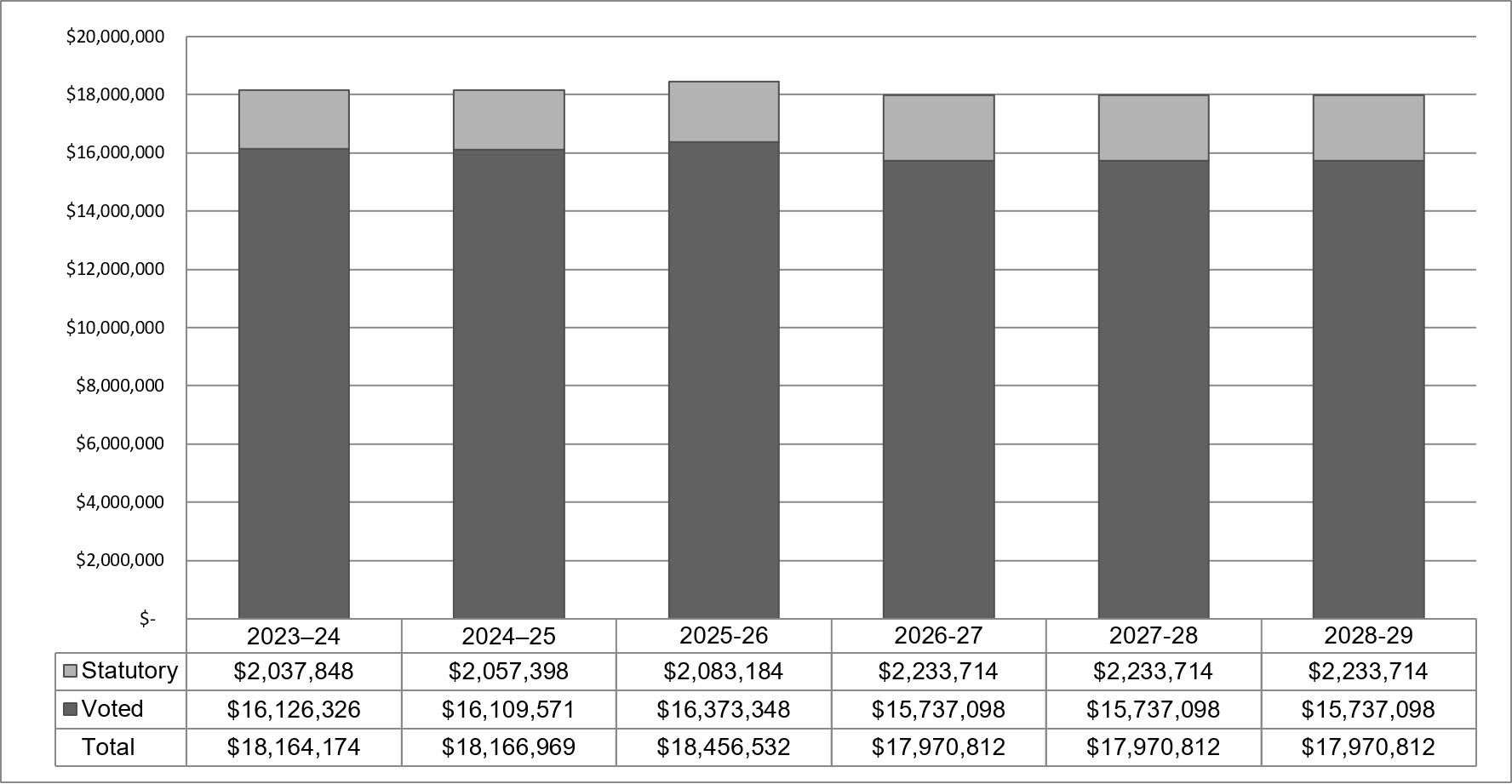
Graph 1: Approved funding (statutory and voted) over a six-year period
Graph 1 summarizes the department's approved voted and statutory funding from 2023-24 to 2028-29.
Text version
| Fiscal year | Total | Voted | Statutory |
|---|---|---|---|
| 2023–24 | 18,164,174 | 16,126,326 | 2,037,848 |
| 2024–25 | 18,166,969 | 16,109,571 | 2,057,398 |
| 2025–26 | 18,456,532 | 16,373,348 | 2,083,184 |
| 2026–27 | 17,970,812 | 15,737,098 | 2,233,714 |
| 2027–28 | 17,970,812 | 15,737,098 | 2,233,714 |
| 2028–29 | 17,970,812 | 15,737,098 | 2,233,714 |
Analysis of statutory and voted funding over a six-year period
The OIC spent $18.2 million in 2024–25 to carry out its program and meet its strategic outcome, which was consistent with the spending in 2023–24.
The OIC expects to spend $18.5 million in 2025–26, a small increase from prior year largely due to planned spending of amounts carried forward from the prior year.
Spending in 2026–27 and ongoing is expected to be approximately $17.9 million as funding remains at base levels. Planned spending in 2026–27 and later years does not include any additional funding for new collective agreements after the current ones expire in the next several years. When these new collective agreements are signed, the OIC expects to receive additional funding from TBS to cover the full cost of these agreements.
The Commissioner is committed to ensuring that the OIC uses its financial resources in the most strategic and responsible manner to continually improve service delivery and ensure that investigations and other activities aimed at enhancing government openness and transparency have the most impact. The vast majority of the OIC’s spending (88% in 2024–25) was for salaries and associated employee costs.
For further information on the OIC’s departmental appropriations, consult the 2026–27 Main Estimates.
Future-oriented condensed statement of operations
The future-oriented condensed statement of operations provides an overview of the OIC’s operations for 2025–26 to 2026–27.
Table 7: Future-oriented condensed statement of operations for the year ended March 31, 2027 (dollars)
Table 7 summarizes the expenses and revenues which net to the cost of operations before government funding and transfers for 2025–26 to 2026–27. The forecast and planned amounts in this statement of operations were prepared on an accrual basis. The forecast and planned amounts presented in other sections of the Departmental Plan were prepared on an expenditure basis. Amounts will therefore differ.
| Financial information | 2025-26 Forecast results | 2026-27 Planned results | Difference (Planned results minus forecasted) |
|---|---|---|---|
| Total expenses | 21,211,532 | 20,640,812 | –570,720 |
| Total revenues | – | – | – |
| Net cost of operations before government funding and transfers | 21,211,532 | 20,640,812 | –570,720 |
Analysis of forecasted and planned results
Planned spending in 2026–27 is expected to be lower as the 2025–26 forecast results includes amounts carried forward from prior years that the OIC plans to spend in 2025-26.
Parliamentary authorities
The OIC is financed by the Government of Canada through parliamentary authorities. Financial reporting of authorities provided to the OIC differs from financial reporting according to generally accepted accounting principles because authorities are based mainly on cash flow requirements. Items recognized in the Future-Oriented Statement of Operations in one year may be funded through parliamentary authorities in prior, current or future years. Accordingly, the OIC has a different net cost of operations for the year on a government funding basis than on an accrual accounting basis. The differences are reconciled in the following table.
Table 8: Reconciliation of net costs of operations to authorities forecast
Table 8 shows a reconciliation of the net cost of operations before government funding and transfers from the Future-Oriented Statement of Operations to the authorities forecast.
| Financial information | 2025-26 Forecastresults | 2026-27 Planned results |
|---|---|---|
| Net cost of operations before government funding and transfers | 21,211,532 | 20,640,812 |
| Adjustment for items affecting net cost of operations but not affecting authorities: | ||
| Amortization of tangible capital assets | –620,000 | –670,000 |
Services provided without charge by other government departments | –2,300,000 | –2,400,000 |
| Total items affecting net cost of operations but not affecting authorities | –2,920,000 | –3,070,000 |
| Adjustments for items not affecting net cost of operations but affecting authorities: | ||
Acquisitions of tangible capital assets | 165,000 | 400,000 |
| Total items not affecting net cost of operations but affecting authorities | 165,000 | 400,000 |
| Requested authorities forecasted to be used | 18,456,532 | 17,970,812 |
Human resources
This section presents an overview of the department’s actual and planned human resources from 2023–24 to 2028–29.
Table 9: Actual human resources for core responsibilities and internal services
Table 9 shows a summary of human resources, in full-time equivalents, for the OIC’s core responsibilities and for its internal services for the previous three fiscal years. Human resources for the 2025–26 fiscal year are forecasted based on year to date.
| Core responsibilities and internal services | 2023-24 Actual full-time equivalents | 2024-25 Actual full-time equivalents | 2025-26 Forecasted full-time equivalents |
|---|---|---|---|
| Government Transparency | 87 | 88 | 95 |
| Subtotal | 87 | 88 | 95 |
| Internal services | 33 | 31 | 29 |
| Total | 120 | 119 | 124 |
Analysis of human resources over the last three years
The actual number of FTEs in 2024–25 was consistent with 2023–24. In 2025–26, the OIC is expecting to reach its maximum FTEs of 124.
Table 10: Human resources planning summary for core responsibilities and internal services
Table 10 shows information on human resources, in full-time equivalents, for each of the OIC’s core responsibilities and for its internal services planned for the next three years.
| Core responsibilities and internal services | 2026-27 Planned full-time equivalents | 2027-28 Planned full-time equivalents | 2028-29 Planned full-time equivalents |
|---|---|---|---|
| Government Transparency | 95 | 95 | 95 |
| Subtotal | 95 | 95 | 95 |
| Internal services | 29 | 29 | 29 |
| Total | 124 | 124 | 124 |
Analysis of human resources for the next three years
The OIC had originally planned for 129 FTEs for the next three years. Due to the unanticipated structural deficit resulting from the cost of covering unfunded salary increases under new collective agreements, the planned FTEs have been reduced to 124.
Supplementary information tables
Information on the OIC’s departmental sustainable development strategy can be found on the OIC’s website.
Federal tax expenditures
The OIC’s Departmental Plan does not include information on tax expenditures.
The tax system can be used to achieve public policy objectives through the application of special measures such as low tax rates, exemptions, deductions, deferrals and credits. The Department of Finance Canada publishes cost estimates and projections for these measures each year in the Report on Federal Tax Expenditures.
This report also provides detailed background information on tax expenditures, including descriptions, objectives, historical information and references to related federal spending programs as well as evaluations and GBA Plus of tax expenditures.
Corporate information
Departmental contact information
Mailing address:
France Labine
Deputy Commissioner, Corporate Services, Strategic Planning and Transformation Services
Office of the Information Commissioner of Canada
30 Victoria Street, Gatineau
QC, K1A 1H3
Telephone: 819-994-8181
Email: information@oic-ci.gc.ca
Website: www.oic-ci.gc.ca
Definitions
appropriation (crédit)
Any authority of Parliament to pay money out of the Consolidated Revenue Fund.
budgetary expenditures (dépenses budgétaires)
Operating and capital expenditures; transfer payments to other levels of government, departments or individuals; and payments to Crown corporations.
core responsibility (responsabilité essentielle)
An enduring function or role performed by a department. The intentions of the department with respect to a core responsibility are reflected in one or more related departmental results that the department seeks to contribute to or influence.
Departmental Plan (plan ministériel)
A report on the plans and expected performance of an appropriated department over a 3year period. Departmental Plans are usually tabled in Parliament each spring.
departmental result (résultat ministériel)
A consequence or outcome that a department seeks to achieve. A departmental result is often outside departments’ immediate control, but it should be influenced by program-level outcomes.
departmental result indicator (indicateur de résultat ministériel)
A quantitative measure of progress on a departmental result.
departmental results framework (cadre ministériel des résultats)
A framework that connects the department’s core responsibilities to its departmental results and departmental result indicators.
Departmental Results Report (rapport sur les résultats ministériels)
A report on a department’s actual accomplishments against the plans, priorities and expected results set out in the corresponding Departmental Plan.
full-time equivalent (équivalent temps plein)
A measure of the extent to which an employee represents a full person-year charge against a departmental budget. For a particular position, the full-time equivalent figure is the ratio of number of hours the person actually works divided by the standard number of hours set out in the person’s collective agreement.
gender-based analysis plus (GBA Plus) (analyse comparative entre les sexes plus [ACS Plus])
Is an analytical tool used to support the development of responsive and inclusive policies, programs, and other initiatives. GBA Plus is a process for understanding who is impacted by the issue or opportunity being addressed by the initiative; identifying how the initiative could be tailored to meet diverse needs of the people most impacted; and anticipating and mitigating any barriers to accessing or benefitting from the initiative. GBA Plus is an intersectional analysis that goes beyond biological (sex) and socio-cultural (gender) differences to consider other factors, such as age, disability, education, ethnicity, economic status, geography (including rurality), language, race, religion, and sexual orientation.
Using GBA Plus involves taking a gender- and diversity-sensitive approach to our work. Considering all intersecting identity factors as part of GBA Plus, not only sex and gender, is a Government of Canada commitment.
government priorities (priorités gouvernementales)
For the purpose of the 2026-27 Departmental Plan, government priorities are the high-level themes outlining the government’s agenda in the 2025 Speech from the Throne.
horizontal initiative (initiative horizontale)
An initiative where two or more federal departments are given funding to pursue a shared outcome, often linked to a government priority.
Indigenous business (entreprise autochtones)
Requirements for verifying Indigenous businesses for the purposes of the departmental result report are available through the Indigenous Services Canada Mandatory minimum 5% Indigenous procurement target website.
non-budgetary expenditures (dépenses non budgétaires)
Non-budgetary authorities tShat comprise assets and liabilities transactions for loans, investments and advances, or specified purpose accounts, that have been established under specific statutes or under non-statutory authorities in the Estimates and elsewhere. Non-budgetary transactions are those expenditures and receipts related to the government's financial claims on, and obligations to, outside parties. These consist of transactions in loans, investments and advances; in cash and accounts receivable; in public money received or collected for specified purposes; and in all other assets and liabilities. Other assets and liabilities, not specifically defined in G to P authority codes are to be recorded to an R authority code, which is the residual authority code for all other assets and liabilities.
performance (rendement)
What a department did with its resources to achieve its results, how well those results compare to what the department intended to achieve, and how well lessons learned have been identified.
performance indicator (indicateur de rendement)
A qualitative or quantitative means of measuring an output or outcome, with the intention of gauging the performance of a department, program, policy or initiative respecting expected results.
plan (plan)
The articulation of strategic choices, which provides information on how a department intends to achieve its priorities and associated results. Generally, a plan will explain the logic behind the strategies chosen and tend to focus on actions that lead to the expected result.
planned spending (dépenses prévues)
For Departmental Plans and Departmental Results Reports, planned spending refers to those amounts presented in Main Estimates.
A department is expected to be aware of the authorities that it has sought and received. The determination of planned spending is a departmental responsibility, and departments must be able to defend the expenditure and accrual numbers presented in their Departmental Plans and Departmental Results Reports.
program (programme)
Individual or groups of services, activities or combinations thereof that are managed together within the department and focus on a specific set of outputs, outcomes or service levels.
program inventory (répertoire des programmes)
Identifies all the department’s programs and describes how resources are organized to contribute to the department’s core responsibilities and results.
result (résultat)
A consequence attributed, in part, to a department, policy, program or initiative. Results are not within the control of a single department, policy, program or initiative; instead they are within the area of the department’s influence.
statutory expenditures (dépenses législatives)
Expenditures that Parliament has approved through legislation other than appropriation acts. The legislation sets out the purpose of the expenditures and the terms and conditions under which they may be made.
target (cible)
A measurable performance or success level that a department, program or initiative plans to achieve within a specified time period. Targets can be either quantitative or qualitative.
voted expenditures (dépenses votées)
Expenditures that Parliament approves annually through an appropriation act. The vote wording becomes the governing conditions under which these expenditures may be made.