
2025-26 Departmental Results Report
Contents
- At a glance
- From the Commissioner
- Results: What we achieved
- Spending and human resources
- Supplementary information tables
- Information from discontinued statutory reports
- Federal tax expenditures
- Corporate information
- Definitions
At a glance
This departmental results report details the Office of the information Commissioner’s actual accomplishments against the plans, priorities and expected results outlined in its 2025–26 Departmental Plan.
These results align with the Office of the Information Commissioner’s vision, mission, values, and strategies.
Key priorities
The Office of the Information Commissioner identified the following key priorities for 2025–26:
- Investing in and supporting our resources: continue to advocate for a funding model that provides the OIC with the resources needed to operate and reflects the Commissioner’s status as an independent agent of Parliament
- Innovating and transforming operations: provide tools to the OIC to consistently improve its annual performance by assigning and concluding investigations more rapidly and to excel in a hybrid work environment
- Maintaining and enhancing the organization’s credibility: upholding the right of access to information through the OIC’s investigations and reports, continue to issue orders, as needed, and seek to ensure their enforcement through litigation where necessary. In the lead-up to the next review of the Access to Information Act, contribute to finding new ways to make information available through means other than access requests to provide relief to an overstretched system.
Highlights
- Total actual spending (including internal services): $17,923,958
- Total full-time equivalent staff (including internal services): 119
For detailed information on the OIC’s total spending and human resources, read the Spending and human resources section of this report.
Summary of results
The following provides a summary of the results the department achieved in 2025–26 under its “core responsibility” (its main areas of activity).
Core responsibility: Government Transparency
Actual spending: $12,862,249
Actual human resources: 90
In fiscal year 2025–26, the OIC continued to enhance its operations to better serve the public. Efficient resource management, including optimizing office space, modernizing information management tools, and reallocating funds to bolster investigative capacity were strategic priorities for the reporting period. A major undertaking included transitioning to a new information management system, leading to a stronger culture of information, stewardship and collaboration between sectors.
Over the course of the year, 5,839 complaints were submitted to the OIC and 5,894 were concluded. Of the new complaints submitted, 67% were found to be admissible, ensuring that only complaints falling within the scope of the Commissioner’s mandate were assigned to investigators.
The Commissioner has the authority to cease investigating complaints when an investigation is no longer necessary. This most often occur when a complainant has received a response to their access request through the OIC’s intervention. This allows the OIC’s resources to focus on complaints where requesters are still awaiting access to the information they seek. The OIC also continued to make progress resolving the most complex complaints in its inventory allowing the OIC to begin 2026–27 with an inventory largely composed of complaints that were either under active investigation or had recently been submitted and were awaiting assignment to an investigator. Working on contemporary complaints is the most efficient use of resources for both the OIC and the institutions subject to the Act.
The volume of complaints submitted to the OIC varies annually. Although numerous factors—such as the level of resources dedicated to institutions’ access to information and privacy units—can affect complaint volume, the OIC does not have the ability to regulate or predict the number of complaints it will receive in any given year.
During 2025–26, the OIC found 3,900 complaints to be admissible and concluded 3,955 complaints through investigations, reducing its inventory by 55 complaints. As of March 31, 2026, the inventory stood at 2,155 active complaints, of which only 9% were submitted more than two years ago. This surpassed the Commissioner’s goal of having no more than 15% of active complaints be more than two years old.
For more information on the OIC’s work under government transparency, read the “Results – what we achieved” section of its departmental results report.
From the Commissioner

Caroline Maynard
Information Commissioner of Canada
The tabling of the Office of Information Commissioner’s (OIC) 2025–26 Departmental Results Report marks an important opportunity to reflect on the progress made during the first year of my renewed mandate and to assess the impact of the priorities set out in my 2025–26 Departmental Plan.
My reappointment in November 2024 provided continuity for the OIC and stability within the federal access to information system. In the year that followed, my Office remained focused on its core responsibilities—investigating complaints and supporting Parliament—while advancing key initiatives aimed at improving transparency, strengthening compliance, and enhancing operational efficiency.
Throughout 2025–26, we continued to promote a culture of “transparency by default” across federal institutions. This work included sustained engagement with public servants at all levels to reinforce their responsibilities under the Access to Information Act and to encourage the proactive disclosure of information. These efforts are essential to alleviating pressures on a system that continues to face significant challenges, including persistent delays and the over-application of exemptions and redactions.
At the same time, my Office maintained a strong focus on ensuring compliance with the Act. I exercised my full range of authorities, including issuing orders and, where necessary, pursuing legal recourse to uphold the right of access. We also completed a systemic investigation, first launched in 2024, into matters related to requesting and obtaining access to information concerning the ArriveCAN application at the Canada Boarder Services Agency. I issued a final report that included numerous recommendations to address the shortcomings I identified.
Over the past year, collaboration has been another key pillar of our work. Consistent with the commitments set out in my Departmental Plan, and in line with the joint resolution adopted with my provincial and territorial counterparts in late 2024, we continued to work with partners across jurisdictions to advance shared principles of transparency and accountability.
Looking ahead, the review of the Access to Information Act remains a critical opportunity to modernize Canada’s federal access regime. During 2025–26, my Office actively contributed to discussions on reform, advocating for legislative changes that reflect current technological realities, strengthen oversight, and ensure that the system is optimized to uphold the right of access to information.
The ongoing challenges observed in information management and the timely provision of access underscore the need for sustained attention, innovation, and commitment from all participants in the system. By maintaining our focus on transparency, compliance, collaboration, and modernization, my team and I will continue to uphold and advance the fundamental right of access to information for all Canadians.
Together, these efforts reaffirm the OIC’s essential role in promoting accountability and strengthening trust in Canada’s federal institutions.
Caroline Maynard
Information Commissioner of Canada
Results: What we achieved
Core responsibility and internal services
Core responsibility: Government Transparency
In this section
- Description
- Quality of life impacts
- Progress on results
- Details on results
- Key risks
- Resources required to achieve results
- Related government priorities
- Program inventory
Description
The Information Commissioner is the first level of independent review of government decisions relating to requests for information under the control of government institutions. The second level of independent review is performed by the Federal Court
Quality of life impacts
This core responsibility contributes to the "Good Governance" theme of the Quality of Life Framework for Canada and, more specifically, "confidence in institutions," through all activities associated with Government transparency.
Progress on results
This section details the OIC’s performance against its targets for each departmental result under Core responsibility: Government transparency
Table 1 shows the target, the date to achieve the target and the actual result for each indicator under “Canadians receive timely resolution of complaints on how federal institutions process access to information requests in the last three fiscal years”.
Table 1: Timely resolution of complaints.
| Departmental result indicator | Target | Date to achieve target | Actual result |
|---|---|---|---|
Percentage of refusal complaints assigned to investigators within 120 days of being registered | At least 85% | March 31, 2026 | 2023–24: 28.1% 2024–25: 30.9% 2025–26: 52.4% |
Percentage of investigations of refusal complaints completed within 270 days | At least 85% | March 31, 2026 | 2023–24: 61.2% 2024–25: 71.2% 2025–26: 71.3% |
Percentage of administrative complaints assigned to investigators within 30 days of being registered | At least 85% | March 31, 2026 | 2023–24: 14.9% 2024–25: 35.5% 2025–26: 48.1% |
Percentage of investigations of administrative complaints completed within 90 days | At least 85% | March 31, 2026 | 2023–24: 78.8% 2024–25: 74.4% 2025–26: 82.8% |
Complaint investigations completed each year is equal to or more than the complaints received | At least 100% | March 31, 2026 | 2023–24: 124.0% 2024–25: 113.0% 2025–26: 100.9% |
Commissioner's orders are published within 120 days of being issued | 100% | March 31, 2026 | 2023–24: 98.0% 2024–25: 97.0% 2025–26: 99.0% |
Refusal complaints concern institutions' application of exemptions and exclusions under the Act, the adequacy of their record searches, the application of fees, the provision of records in a particular official language, the provision of records in alternative formats, publications under section 5 of the Act, and other matters relating to requesting or obtaining access to records.
Administrative complaints involve delay (an institutions' lack of response to access requests within the deadlines set out in the Act) and extension of time allegations (whether the extra time an institution decided to take to respond to a request is reasonable or was taken for legitimate reasons, or whether the institution followed the rules in the Act for taking extensions). Complainants have not yet received a response to their access request.
The OIC is working towards meeting all its targets but also remains committed to balancing the investigation of new complaints and the conclusion of older complaints in its inventory, ensuring fairness and progress. By the end of 2025–26, a minimal number of complaints submitted prior to 2024 remained in the inventory. Maintaining a contemporary inventory will help the OIC achieve its timeliness targets in future years. Various factors continue to influence the pace of investigations, including the increasing complexity of complaints, the sensitivity of information, and the workload of the institutions involved. The OIC continues to focus on streamlining its work processes to maximize productivity. The timely assignment of complaints also requires a skilled and adequately resourced team of investigators, capable of managing the workload effectively. The OIC continues to invest in developing its employees’ expertise and actively backfills vacancies annually. However, budgetary constraints limit its ability to expand its investigative workforce beyond its current capacity.
The Results section of the Infographic for the OIC on GC Infobase provides additional information on results and performance related to its program inventory.
Details on results
The following section describes the results for Government Transparency in 2025–26 compared with the planned results set out in the OIC’s departmental plan for the year.
Canadians receive timely resolution of complaints on how federal institutions process access to information requests
Results achieved
Reduction in the OIC’s inventory
By the end of 2025–26, the Commissioner concluded numerous new complaints and most of the complaints that were more than two years old in the inventory. During 2025–26, the OIC Registry found 3,900 complaints to be admissible and concluded 1,939 complaints by finding them inadmissible or closing them for other reasons. In addition, 3,955 complaints were completed through investigations, contributing to a further reduction in the inventory.
Only 9% of the complaints in inventory had been submitted on or before March 31, 2024. Whereas investigating older complaints can often present numerous challenges due to the passage of time. Working on contemporary complaints is generally more efficient because the information regarding how the underlying access requests were processed is contemporary, readily available, and easier to verify.
Whenever possible, complaints are resolved through discussions between the parties, clarification of issues, or other means. This remains the most efficient and preferred approach to concluding complaints. Where it is not appropriate or successful, the Commissioner will exercise the full extent of her investigative powers. She will also issue orders, as needed, when complaints are well founded. During 2025–26, the Commissioner issued 340 orders, the majority of which related to delay complaints.
The OIC continues to publish final reports and orders in CANLII and in its public Decisions Database to shed light for complainants and institutions on the Commissioner's decisions and her interpretation and application of the Act. Increasingly, institutions and complainants refer to published decisions to support their arguments and negotiate whenever possible, a resolution to the issue at hand.
Consistently high levels of litigation
The Commissioner's orders are legally binding, meaning that institutions must implement them unless they apply to the Federal Court for a review. Reviews under the Act are generally initiated by parties who are dissatisfied with the outcome of the Commissioner's investigation or with the subject matter of her orders. As a result, the Commissioner has limited control over the volume of incoming litigation.
The OIC handles all litigation internally, generating cost savings and efficiencies while benefiting from the specialized knowledge and experience of its Legal Services unit members in access to information law. However, during 2025–26, the OIC continued to experience consistently high levels of new court proceedings that required its involvement. Among those court proceedings, the Commissioner applied for a writ of mandamus against a head of an institution on one occasion because the institution had not taken the required action: they had neither implemented her order nor applied to the Federal Court for a review. In this instance, the application was discontinued upon the institution complying with the Commissioner’s order.
The majority of the reviews under the Act were applied for by institutions. A large proportion of these proceedings related to delay complaints, where the Commissioner had ordered the institution to respond to the access request at issue by a certain time. These proceedings are frequently discontinued when the institution ultimately responds to the access request but nonetheless generate significant amounts of work for the OIC Legal Services unit. In 2025–26, one application relating to a delay complaint was heard by the Federal Court. The Commissioner is currently awaiting a decision on that matter.
Of the reviews commenced under the Act, four such proceedings related to exemption complaints investigated by the OIC. While lower in number, these types of proceedings consume a large portion of the OIC Legal Services unit’s resources. Regardless of the outcomes, these types of reviews assist in the development of the body of law governing federal access to information requests.
Driving efficiency: continued progress
In 2025–26, all departmental performance results improved compared with the previous year, demonstrating continued progress across key performance indicators. These results are due in part to the OIC’s effective implementation of its Professional Development Program for Investigators in order to attract and retain a diverse and qualified workforce. The OIC recognizes that attracting and retaining a diverse workforce depends on fostering an inclusive work environment. A diverse workforce enhances the organization’s capacity to innovate and leverage talent, both now and in the future.
The Investigation Governance and Strategic Guidance unit, with the support of the Legal Services unit, also contributed to the efficient delivery of the investigations program by developing more tools and delivering training opportunities for investigators and Registry staff. The Legal Services unit provided continued support to the Commissioner by offering advice on a wide range of internal services and investigation-related issues, including investigations findings and reports, and institutions’ applications seeking the Commissioner’s approval to decline to act on access requests.
Enhancing the efficiency of the OIC’s operations has been a key priority since the outset of the Commissioner’s mandate. In 2025–26, significant progress continued—particularly in the timeliness of complaint assignments—driven by the implementation of new tools and streamlined processes.
Key risks
It is impossible to predict the number of complaints the OIC will receive each year, nor the number of applications for review before the court. Various factors may influence this volume, including the resources allocated to institutions’ access to information and privacy units. This unpredictability creates a major operational risk for the OIC. While funding and resources have remained stable, complaints fluctuate annually, and litigation has risen sharply since 2021–22, with the OIC handling all litigation internally. The OIC has been managing this risk by temporarily reallocating resources internally. Should the volume and complexity of litigation remain high, this will require a reassessment of permanent funding for the OIC’s legal services unit.
Despite its small size, the OIC remains responsible for ensuring that its IT services, infrastructure and support continue to meet operational needs in an evolving technology environment. In recent years, the OIC has modernized parts of its infrastructure by moving selected services to the cloud. This approach reduces the need to maintain the same level of on-premises servers, patching and infrastructure support, allowing existing IT resources to focus more on projects that create value for the organization. However, the transition also requires ongoing investment in cloud services, cybersecurity, software and hardware, at a time when technology costs continue to increase while funding remains static. The OIC’s mitigation strategy is to manage these pressures by prioritizing key modernization initiatives, using carry-forward funds where available, and spreading major technology projects over several years. Going forward, the OIC will continue to assess which additional services or infrastructure components should be moved to the cloud in order to increase efficiency, reduce operational burden and better manage long-term costs.
Although the OIC has been successful in reducing its inventory of complaints, Canadians are still facing longer than necessary delays in accessing the information to which they are entitled. As the Government and the OIC enter a period of greater fiscal restraint, the OIC does not want to lose the progress it has made. Although the OIC is committed to ensuring that financial resources are spent responsibly, there is the potential that limited financial resources will impact the public’s right of access. The OIC will continue to advocate for a funding model that reflects the Commissioner’s independence and provides the resources required to meet its mandate and that maintains Canadians’ confidence in the access to information system.
Resources required to achieve results
Table 2 provides a summary of the planned and actual spending and full-time equivalents required to achieve results.
Table 2: Snapshot of resources required for Government Transparency
| Resource | Planned | Actual |
|---|---|---|
Spending | 12,417,529 | 12,862,249 |
Full-time equivalents | 95 | 90 |
The Finances section of the Infographic for the OIC on GC Infobase page and the People section of the Infographic for the OIC on GC Infobase page provide complete financial and human resources information related to its program inventory.
Related government priorities
This section highlights government priorities that are being addressed through this core responsibility.
Gender-based Analysis Plus
The OIC helps Canadians obtain access to information about government activities and decisions, including gender- based (GBA+) information. By giving Canadian’s access to information about government activities and decisions, the OIC has the potential to help the government meet all the goals in its Gender Results Framework. Due to privacy and confidentially requirements, the OIC does not collect or analyze GBA+ data from complainants. However, ensures equal treatment and prevents discrimination in any form.
In 2024–25, the OIC completed a complainant consultation about its program delivery, including the accessibility and inclusivity of its investigation processes. Complainants identified no significant barriers.
Artificial intelligence
As the Government has noted in its AI Strategy for the Federal Public Service 2025–2027, artificial intelligence (AI) provides enormous potential benefits through more efficient operations and enhanced service delivery for Canadians. Along with the benefits, AI also introduces new risks. The OIC is committed to the responsible use of AI, including addressing risks related to cost, security, privacy and the accuracy, reliability, and effective use of AI-generated outputs.
To support the adoption of AI, the OIC has released guidelines and introduced mandatory training on the appropriate use of generative AI tools to help employees understand their roles and responsibilities when using this technology, and to provide guidance on how to benefit from AI tools while mitigating risk. At present, OIC employees may use AI with non-sensitive data, and AI tools are being used across the OIC for tasks such as editing texts, generating images for presentations, summarizing publicly available information, brainstorming, research, learning, and translation of internal text.
Beyond these general applications, some areas of the organization have implemented specialized AI solutions to support their operations. Over the past two years, the OIC’s Linguistic Services unit has integrated an AI-based neural machine translation tool combined with a translation memory system to optimize its operations. The objective is to reduce the translation costs while maintaining the quality of translated content.
The OIC has also made significant investments in new IT and IM systems in recent years. The potential for greater use of AI tools has been an important consideration in shaping these efforts, with the aim of preparing applications and data to support broader AI adoption in the near future, particularly to automate time-consuming, repetitive tasks.
Program inventory
Government Transparency is supported by the following program:
- Compliance with access to information obligations
Additional information related to the program inventory for Government Transparency is available on the Results page on GC InfoBase.
Internal services
In this section
- Description
- Progress on results
- Resources required to achieve results
- Contracts awarded to Indigenous businesses
Description
Internal services are the activities and resources that support a department in meeting its corporate obligations and delivering its programs. The 9 categories of internal services are:
- acquisition management services
- communications services
- financial management services
- human resources management services
- information management services
- information technology services
- material management services
- management and oversight services
- real property management services
Progress on results
This section presents details on how the department performed to achieve results and meet targets for internal services.
Working in partnership with all sectors, Corporate Services enables the OIC to achieve its mandate by providing strategic advice, stewardship, and internal services that foster effective, efficient, and accountable operations. Consistent with this role, the sector has continued to prioritize investments in the Investigations Program, leading to a steady increase in resources over the last five years. This sustained focus has contributed to reducing both the size and the age of complaints in the OIC's inventory.
The spirit of efficiency and innovation that has guided Corporate Services in recent years continued in 2025–26 through ongoing investments by the Information Technology (IT) and Information Management (IM) units. These units worked together to migrate additional services to a cloud computing environment, with the aim of enabling OIC employees to work more efficiently while reducing the operational burden associated with maintaining internal infrastructure. In 2025–26, the IT and IM units also worked closely with the Investigations and Legal Services units to improve the OIC’s case management system used to manage complaints, investigations and legal activities. Building on this progress, the OIC will continue this modernization work in 2026–27, including planning for the transfer of this system solution to the cloud.
Another significant accomplishment in 2025–26 was the establishment of the Optimization Working Group. This initiative brings together employees from across the OIC to identify practical ways to enhance productivity and support more efficient operations. The working group has identified an initial set of priorities focused on targeted investments and solutions that can be implemented within the organization’s existing capacity and resources, while generating meaningful efficiencies for OIC employees.
Although the OIC was exempt from the Government’s Comprehensive Expenditure Review, the Finance unit worked with units across the OIC to undertake a review of spending to ensure that resources were used as efficiently and effectively as possible. Highlights in 2025-26 include reducing the OIC’s office space by approximately 20% while maintaining sufficient workspace capacity for all employees, and hiring additional IT staff to bring more internal expertise to the OIC which will reduce spending on consultants over time. The IT unit also reviewed their spending on software and found innovative ways to reduce or eliminate a number of licenses that will reduce ongoing spending.
In 2025–26, the Public Affairs unit supported the OIC’s mandate through strategic communications, stakeholder engagement, media relations, and outreach activities. The unit enhanced the visibility of the OIC’s work through digital communications, publications, and public reporting, helping to promote awareness of access to information rights and the OIC’s role.
The OIC also continued its leadership role within the federal, provincial, and territorial (FPT) access and privacy community. As Secretariat to the FPT Information and Privacy Commissioners in 2025–26, the OIC coordinated monthly virtual meetings and facilitated collaboration and information sharing among member jurisdictions. In addition, the OIC worked closely with the Office of the Privacy Commissioner of Canada to co-host and coordinate preparations for the 2026 annual FPT meeting in Ottawa, supporting the planning and delivery of a national conference for discussing emerging access to information and privacy issues.
Resources required to achieve results
Table 3 provides a summary of the planned and actual spending and full-time equivalents required to achieve results.
Table 3: Resources required for internal services for 2025–26
| Resource | Planned | Actual |
|---|---|---|
Spending | 5,321,798 | 5,061,709 |
Full-time equivalents | 29 | 29 |
The Finances section of the Infographic for the OIC on GC Infobase and the People section of the Infographic for the OIC on GC Infobase provide complete financial and human resources information related to its program inventory.
Contracts awarded to Indigenous businesses
Government of Canada departments are required to award at least 5% of the total value of contracts to Indigenous businesses every year.
As shown in Table 4, the OIC awarded 57.11% of the total value of all contracts to Indigenous businesses for the fiscal year.
Table 4: Total value of contracts awarded to Indigenous businesses
| Contracting performance indicator | 2025–26 result |
|---|---|
Total value of contracts awarded to Indigenous businesses (A) | $704,050.07 |
Total value of contracts awarded to Indigenous and non‑Indigenous businesses (B) | $1,232,825.54 |
Value of exceptions approved by deputy head (C) | $0 |
Proportion of contracts awarded to Indigenous businesses [A / (B−C) × 100] | 57.11% |
Notes For the purposes of the minimum 5% target, Indigenous Services Canada defines “Indigenous businesses” as:
A “contract” is a binding agreement for the procurement of a good, service or construction and does not include real property leases. It includes contract amendments and contracts entered into by means of acquisition cards of more than $10,000. | |
The OIC was required to achieve the minimum 5% target of contracts awarded to Indigenous businesses by the end of 2024–25. The OIC exceeded this target in 2024–25 and has done so every year since 2022–23.
In its 2025–26 Departmental Plan, the OIC estimated that it would award 5% of the total value of its contracts to Indigenous businesses by the end of 2025–26. The OIC was able to exceed this target by procuring IM and IT services from Indigenous firms since these particular segments represent the highest operational expenditures for the organization.
The measures that OIC has taken, and will continue to take, to achieve the 5% minimum target include the following:
- disseminating communiqués to inform OIC budget managers of this commitment;
- ensuring that necessary training is provided to budget managers and contracting specialists; and
- considering the impact of multi-year contacts.
As a small organization, the OIC relies on the Canadian Human Rights Commission (CHRC) for procurement services and will continue to work jointly with CHRC to continue to achieve the 5% target.
Spending and human resources
In this section
Spending
This section presents an overview of the department’s actual and planned expenditures from 2023–24 to 2028–29.
Budgetary performance summary
Table 5 shows the money that the OIC spent in each of the past three years on its core responsibilities and on internal services.
Table 5: Actual three-year spending on core responsibilities and internal services (dollars)
| Core responsibilities and internal services | 2025–26 Main Estimates | 2025–26 total authorities available for use | Actual spending over three years (authorities used) |
|---|---|---|---|
Government Transparency | 12,417,529 | 13,306,307 |
|
Subtotal | $12,417,529 | $13,306,307 | $12,862,249 |
Internal services | 5,321,798 | 5,236,460 |
|
Total | $17,739,327 | $18,542,767 |
|
Analysis of the past three years of spending
The OIC spent $17.9 million in 2025–26 which is slightly lower compared to the two prior years, largely due to less funding received and spent on the implementation of new collective agreements, as well as measures taken during the year to ensure the most efficient use of resources. The total authorities available for use in 2025–26 was $18.5 million, an increase of $0.8 million over the amount included in the Main Estimates mostly due to OIC’s carry forward of funding from 2024–25.
The OIC is committed to spending the maximum amount possible on its core responsibility and minimizing spending on internal services. The percentage spent on government transparency has increased annually from 2023–24 to 2025–26.
The Finances section of the Infographic for the OIC on GC provides more financial information from previous years.
Planned spending for next three years
Table 6 shows the OIC’s planned spending for each of the next three years on its core responsibilities and on internal services.
Table 6: Planned three-year spending on core responsibilities and internal services (dollars)
| Core responsibilities and internal services | 2026–27 planned spending | 2027–28 planned spending | 2028–29 planned spending |
|---|---|---|---|
Government Transparency | 12,579,568 | 12,579,568 | 12,579,568 |
Subtotal | $12,579,568 | $12,579,568 | $12,579,568 |
Internal services | 5,391,244 | 5,391,244 | 5,391,244 |
Total | $17,970,812 | $17,970,812 | $17,970,812 |
Analysis of the next three years of planned spending
The OIC plans to spend $17.9 million in 2026–27 and in ongoing years. The vast majority of the OIC’s spending is for salaries and associated employee costs.
The Finances section of the Infographic for OIC on GC Infobase provides more detailed financial information related to future years.
Funding
This section provides an overview of the department’s voted and statutory funding for its core responsibilities and for internal services.
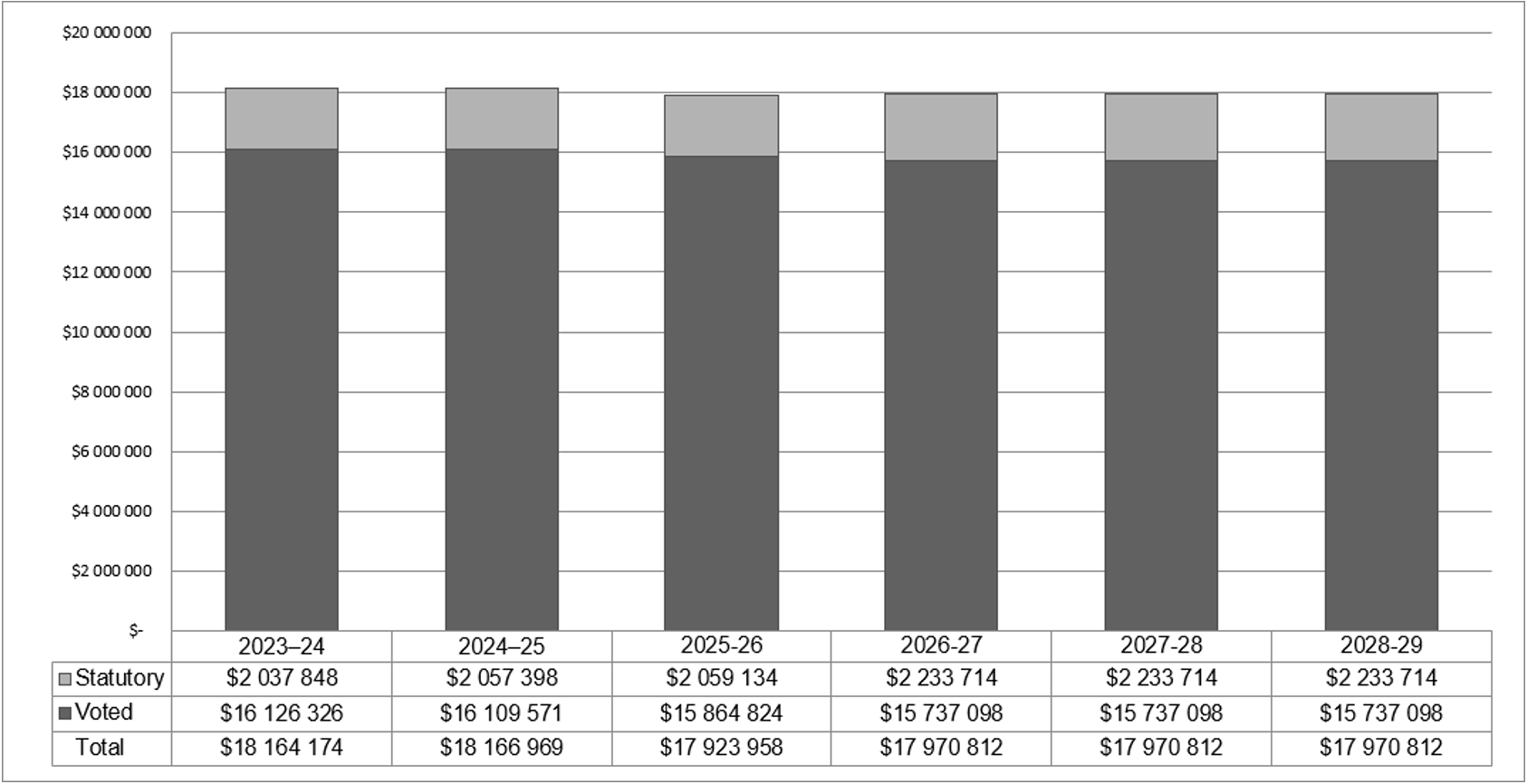
Graph 1 summarizes the department’s approved voted and statutory funding from 2023–24 to 2028–29.
Graph 1: Approved funding (statutory and voted) over a six-year period
Text version
| Fiscal year | Statutory | Voted | Total |
|---|---|---|---|
2023–24 | $2,037,848 | $16,126,326 | $18,164,174 |
2024–25 | $2,057,398 | $16,109,571 | $18,166,969 |
2025–26 | $2,059,134 | $15,864,824 | $17,923,958 |
2026–27 | $2,233,714 | $15,737,098 | $17,970,812 |
2027–28 | $2,233,714 | $15,737,098 | $17,970,812 |
2028–29 | $2,233,714 | $15,737,098 | $17,970,812 |
Analysis of statutory and voted funding over a six-year period
The OIC spent $17.9 million in 2025–26 to carry out its program and meet its strategic outcome, which was slightly lower than previous years largely due to less funding received and spent on the implementation of new collective agreements.
Spending in 2026–27 and ongoing is expected to be approximately $17.9 million as funding remains at base levels. Planned spending in 2026–27 and later years does not include any additional funding for new collective agreements after the current ones expire in the next several years. When these new collective agreements are signed, the OIC expects to receive additional funding from TBS to cover the full cost of these agreements.
The Commissioner is committed to ensuring that the OIC uses its financial resources in the most strategic and responsible manner to continually improve service delivery and ensure that investigations and other activities aimed at enhancing government openness and transparency have the most impact. The vast majority of the OIC’s spending (89% in 2025–26) was for salaries and associated employee costs.
Consult the Public Accounts of Canada for further information on the OIC’s departmental voted and statutory expenditures.
Financial statement highlights
This section presents the OIC’s Financial statements (Audited) for the year ended March 31, 2026.
Table 7 summarizes the expenses and revenues for 2025–26, which net to the cost of operations before government funding and transfers.
Table 7: Condensed Statement of Operations (unaudited) for the year ended March 31, 2026 (dollars)
| Financial information | 2025–26 actual results | 2025–26 planned results | Difference (actual results minus planned) |
|---|---|---|---|
Total expenses | $20,409,514 | $20,584,327 | ($174,813) |
Total revenues | $22,470 | $0 | $22,470 |
Net cost of operations before government funding and transfers | $20,387,044 | $20,584,327 | ($197,283) |
Analysis of expenses and revenues for 2025–26
The OIC’s total expenses were $0.2 million lower than planned for 2025-26, largely due to lower spending on professional services contracts than originally planned. Given that the OIC’s revenues are generally modest and difficult to predict, revenue estimates are not included in planned results.
The 2025–26 planned results information is provided in the OIC’s Future-Oriented Statement of Operations and Notes 2025–26 included in the Departmental Plan.
Table 8 summarizes actual expenses and revenues and shows the net cost of operations before government funding and transfers.
Table 8: Condensed Statement of Operations (unaudited) for 2024–25 and 2025–26 (dollars)
| Financial information | 2025–26 actual results | 2024–25 actual results | Difference (2025–26 minus 2024–25) |
|---|---|---|---|
Total expenses | $20,409,514 | $21,006,462 | ($596,948) |
Total revenues | $22,470 | $40,405 | ($17,935) |
Net cost of operations before government funding and transfers | $20,387,044 | $20,966,057 | ($579,013) |
Analysis of differences in expenses and revenues between 2024–25 and 2025–26
The OIC’s total expenses were $0.6 million lower in 2025-26 compared to 2024-25 largely due to less spending on professional & special services contracts and less spent on rental costs due to the OIC’s reducing its office space in the year.
Table 9 provides a brief snapshot of the amounts the department owes or must spend (liabilities) and its available resources (assets), which helps to indicate its ability to carry out programs and services.
Table 9: Condensed Statement of Financial Position (unaudited) as at March 31, 2026 (dollars)
| Financial information | Actual fiscal year (2025–26) | Previous fiscal year (2024–25) | Difference (2025–26 minus 2024–25) |
|---|---|---|---|
Total net liabilities | $2,616,044 | $2,903,548 | ($287,504) |
Total net financial assets | $1,682,667 | $2,067,749 | ($385,082) |
Departmental net debt | $933,377 | $835,799 | $97,578 |
Total non-financial assets | $1,653,405 | $2,078,505 | ($425,100) |
Departmental net financial position | $720,028 | $1,242,706 | ($522,678) |
Analysis of department’s liabilities and assets since last fiscal year
The OIC’s Departmental net debit is higher by $0.1 million compared to 2024-25. This is due to total net financial assets being lower by $0.4 million mostly due to less amounts being receivable at year-end, offset by total net liabilities being $0.3 million lower due to less amounts being payable at year end in 2025-26.
Total non-financial assets were $0.4 million lower, largely due to the transfer of certain capital assets to Public Services and Procurement Canada following the OIC’s reduction of its office space.
Human resources
This section presents an overview of the department’s actual and planned human resources from 2023–24 to 2028–29.
Table 10 shows a summary in full-time equivalents of human resources for the OIC’s core responsibilities and for its internal services for the previous three fiscal years.
Table 10: Actual human resources for core responsibilities and internal services for the last three years
| Core responsibilities and internal services | 2023–24 actual full-time equivalents | 2024–25 actual full-time equivalents | 2025–26 actual full-time equivalents |
|---|---|---|---|
Government Transparency | 87 | 88 | 90 |
Subtotal | 87 | 88 | 90 |
Internal services | 33 | 31 | 29 |
Total | 120 | 119 | 119 |
Analysis of human resources for the last three years
The actual number of FTEs has been consistent over the last three years. Actual FTEs are generally slightly lower than planned FTEs due to departures in the year which resulted in positions being vacant until a staffing action can be completed, while also ensuring the OIC remains within approved funding for the year.
Table 11 shows the planned full-time equivalents for each of the OIC’s core responsibilities and for its internal services for the next three years. Human resources for the current fiscal year are forecast based on year to date.
Table 11: Human resources planning summary for core responsibilities and internal services for the next three years
| Core responsibilities and internal services | 2026–27 planned full-time equivalents | 2027–28 planned full-time equivalents | 2028–29 planned full-time equivalents |
|---|---|---|---|
Government Transparency | 95 | 95 | 95 |
Subtotal | 95 | 95 | 95 |
Internal services | 29 | 29 | 29 |
Total | 124 | 124 | 124 |
Analysis of human resources for the next three years
The OIC had originally planned for 129 FTEs for the next three years. Due to the unanticipated structural deficit, resulting from the cost of covering unfunded salary increases under new collective agreements, the planned FTEs have been reduced to 124 FTEs.
Supplementary information tables
The following supplementary information tables are available on the OIC’s website:
Information from discontinued statutory reports
In accordance with section 157 of the Financial Administration Act, the OIC no longer completes the following report:
- Departmental Sustainable Development Strategy Report
This reporting requirement was removed for the OIC and many other small organizations across the government starting in 2025-26.
To reference this information from prior years, consult the 2024 to 2025 Departmental Sustainable Development Strategy Report.
Federal tax expenditures
The tax system can be used to achieve public policy objectives through the application of special measures such as low tax rates, exemptions, deductions, deferrals and credits. The Department of Finance Canada publishes cost estimates and projections for these measures each year in the Report on Federal Tax Expenditures. This report also provides detailed background information on tax expenditures, including descriptions, objectives, historical information and references to related federal spending programs as well as evaluations and GBA Plus of tax expenditures.
Corporate information
Departmental profile
Institutional head: Caroline Maynard
Enabling instrument: Access to Information Act
Year of incorporation or commencement: 1983
Departmental contact information
Mailing address: 30 Victoria Street, Gatineau, Quebec K1A 1H3
Telephone: 1-800-267-0441
Email: https://www.oic-ci.gc.ca/en/form/contact-oic-form
Website(s): http://www.oic-ci.gc.ca/
Definitions
appropriation (crédit)
Any authority of Parliament to pay money out of the Consolidated Revenue Fund.
budgetary expenditures (dépenses budgétaires)
Operating and capital expenditures; transfer payments to other levels of government, departments or individuals; and payments to Crown corporations.
core responsibility (responsabilité essentielle)
An enduring function or role of a department. The departmental results listed for a core responsibility reflect the outcomes that the department seeks to influence or achieve.
Departmental Plan (plan ministériel)
A report that outlines the anticipated activities and expected performance of an appropriated department over a three-year period. Departmental Plans are usually tabled in Parliament in spring.
departmental priority (priorité)
A plan, project or activity that a department focuses and reports on during a specific planning period. Priorities represent the most important things to be done or those to be addressed first to help achieve the desired departmental results.
departmental result (résultat ministériel)
A high-level outcome related to the core responsibilities of a department.
departmental result indicator (indicateur de résultat ministériel)
A quantitative or qualitative measure that assesses progress toward a departmental result.
departmental results framework (cadre ministériel des résultats)
A framework that connects the department’s core responsibilities to its departmental results and departmental result indicators.
Departmental Results Report (rapport sur les résultats ministériels)
A report outlining a department’s accomplishments against the plans, priorities and expected results set out in the corresponding Departmental Plan.
Full-time equivalent (équivalent temps plein)
Measures the person years in a departmental budget. An employee’s scheduled hours per week divided by the employer’s hours for a full-time workweek calculates a full-time equivalent. For example, an employee who works 20 hours in a 40-hour standard workweek represents a 0.5 full-time equivalent.
Gender-based Analysis Plus (GBA Plus) (analyse comparative entre les sexes plus [ACS Plus])
An analytical tool that helps to understand the ways diverse individuals experience policies, programs and other initiatives. Applying GBA Plus to policies, programs and other initiatives helps to identify the different needs of the people affected, the ways to be more responsive and inclusive, and the methods to anticipate and mitigate potential barriers to accessing or benefitting from the initiative. GBA Plus goes beyond biological (sex) and socio-cultural (gender) differences to consider other factors, such as age, disability, education, ethnicity, economic status, geography (including rurality), language, race, religion, and sexual orientation.
government priorities (priorités pangouvernementales)
For the purpose of the 2025–26 Departmental Results Report, government priorities are the high-level themes outlining the government’s agenda as announced in the 2025 Speech from the Throne.
horizontal initiative (initiative horizontale)
A program, project or other initiative where two or more federal departments receive funding to work collaboratively on a shared outcome usually linked to a government priority, and where the ministers involved agree to designate it as horizontal. Specific reporting requirements apply, including that the lead department must report on combined expenditures and results.
Indigenous business (entreprise autochtones)
Requirements for verifying Indigenous businesses for the purposes of the departmental result report are available through the Indigenous Services Canada Mandatory minimum 5% Indigenous procurement target website.
non-budgetary expenditures (dépenses non budgétaires)
Net outlays and receipts related to loans, investments and advances, which change the composition of the financial assets of the Government of Canada.
performance (rendement)
What a department did with its resources to achieve its results, how well those results compare to what the department intended to achieve, and how well lessons learned have been identified.
performance indicator (indicateur de rendement)
A qualitative or quantitative measure that assesses progress toward a departmental-level or program-level result, or the expected outputs or outcomes of a program, policy or initiative.
plan (plan)
The articulation of strategic choices, which provides information on how a department intends to achieve its priorities and associated results. Generally, a plan will explain the logic behind the strategies chosen and tend to focus on actions that lead to the expected result.
planned spending (dépenses prévues)
For Departmental Plans and Departmental Results Reports, planned spending refers to the amounts presented in Main Estimates. Departments must determine their planned spending and be able to defend the financial numbers presented in their Departmental Plans and Departmental Results Reports.
program (programme)
An Individual, group, or combination of services and activities managed together within a department and focused on a specific set of outputs, outcomes or service levels.
program inventory (répertoire des programmes)
A listing that identifies all the department’s programs and the resources that contribute to delivering on the department’s core responsibilities and achieving its results.
result (résultat)
An outcome or output related to the activities of a department, policy, program or initiative.
statutory expenditures (dépenses législatives)
Spending approved through legislation passed in Parliament, other than appropriation acts. The legislation sets out the purpose and the terms and conditions of the expenditures.
target (cible)
A quantitative or qualitative, measurable goal that a department, program or initiative plans to achieve within a specified time period.
voted expenditures (dépenses votées)
Spending approved annually through an appropriation act passed in Parliament. The vote also outlines the conditions that govern the spending.
Gender-based Analysis Plus
Section 1: institutional GBA Plus governance and capacity
Governance
The OIC’s implementation of the GBA+ is supported by a strong organizational governance structure. The structure provides for direct reporting from the Equity, Diversity and Inclusion committee to the organizational head. The OIC covers full spectrum of GBA+ categories, and does not have a specific target group.
Capacity
The OIC will further strengthen organizational measures rooted in the GBA Plus framework, with a strategic focus on enhancing mental health support, accommodation practices, and fostering a deeply inclusive culture. These efforts are directly informed by recent employee survey insights, ensuring that initiatives are responsive to staff needs and conducive to a supportive workplace environment.
Section 2: gender and diversity impacts, by program
Core responsibility: Government Transparency
Program name: Canadians receive timely resolution of complaints on how federal institutions process access to information requests.
Program goals: By giving Canadian’s access to information about government activities and decisions, the OIC has the potential to help the government meet all of the goals in its Gender Results Framework. As complainants remain anonymous, the privacy requirements hamper GBA+ data collection efforts to some extent, however, they ensure equal treatment and prevent discrimination in any form.
Target population: All Canadians
Distribution of benefits: The Access to Information program benefits all Canadians equally.
Key program impacts on gender and diversity: They key impact of the program is ensuring all Canadians receive timely resolution of complaints on how federal institutions process access to information requests.