
Risk-based Audit and Evaluation Plan 2026-27 to 2029-30
Executive Summary
Introduction
This document outlines the Risk-Based Audit and Evaluation Plan (RBAEP) for the Office of the Information Commissioner of Canada (OIC), which was updated in April 2026. The RBAEP encompasses both the internal audit plan and the evaluation plan, covering the period up to the end of 2029/30. The primary aim of the RBAEP is to allocate assurance and evaluation resources to the areas of the OIC that pose the most significant risks and align with the priorities at the OIC. This RBEAP was developed in accordance with the Treasury Board Secretariat (TBS) Policy on Results and Policy on Internal Audit.
This RBAEP is based on the OIC’s Corporate Risk Profile that was updated in February 2026. Furthermore, The RBAEP builds upon the OIC's previous RBAEP and the Office of Comptroller General's (OCG’s) Risk-based Internal Audit Plan for 2024-25 to 2025-26.
As an Agent of Parliament, the OIC reports directly to Parliament and is excluded from the traditional oversight by TBS. However, the OIC recognizes the importance of an audit and evaluation committee and views its internal oversight mechanisms and governance structure as essential in ensuring that adequate management practices are in place.
Proposed Audits and Evaluations
| Year | Audit Project Name | Primary OIC Entity |
|---|---|---|
2026-27 | Internal Audit of Procurement (planning and information gathering) | Finance & Procurement at Canadian Human Rights Commission (CHRC) |
2027-28 | Internal audit of Procurement (audit execution and reporting) | Finance & Procurement at Canadian Human Rights Commission (CHRC) |
2028-29 | One year planned hiatus from internal audits and evaluations to respond to management action plan for internal audit of procurement | |
2029-30 | Internal Audit of Human Resources – Employee Retention (Planned) | Human Resources |
Planning Context
Background
The Information Commissioner is an Agent of Parliament appointed under the Access to Information Act. The Office of the Information Commissioner was established in 1983 under the Access to Information Act to support the work of the Information Commissioner of Canada.
OIC staff carry out confidential investigations into complaints against federal institutions about matters related to an access request or any other matters related to requesting and accessing records under their control giving complainants and any other parties the opportunity to present their positions. OIC counsel handle litigation in reviews before the Federal Court of matters that are the subject of a complaint or of an order from the Commissioner.
OIC strives to maximize compliance with the Act, using the full range of tools, activities and powers at the Commissioner’s disposal. These include negotiating with complainants and making recommendations and/or orders when complaints are well founded.
Caroline Maynard was re-appointed to the position of Information Commissioner of Canada for a second seven-year term beginning on March 1, 2025.
OIC Strategic Priorities
As stated in the OIC’s updated strategic plan, the organization will pursue three strategies to achieve its vision, mission and values:
- Investing our resources effectively
- Innovate and optimize operations
- Maintain and enhance credibility
OIC Structure and Resources
The OIC’s financial and human resources are shown in the table below.
| OIC’s Voted and Statutory Items (thousands of dollars) | Planned Spending 2026-27 | Planned Spending 2027-28 | Planned Spending 2028-29 |
|---|---|---|---|
Government Transparency | $12.4 million | $12.4 million | $12.4 million |
Internal Services | $5.3 million | $5.3 million | $5.3 million |
Total | $17.7 million | $17.7 million | $17.7 million |
Total full-time equivalents (FTE) | 124 | 124 | 124 |
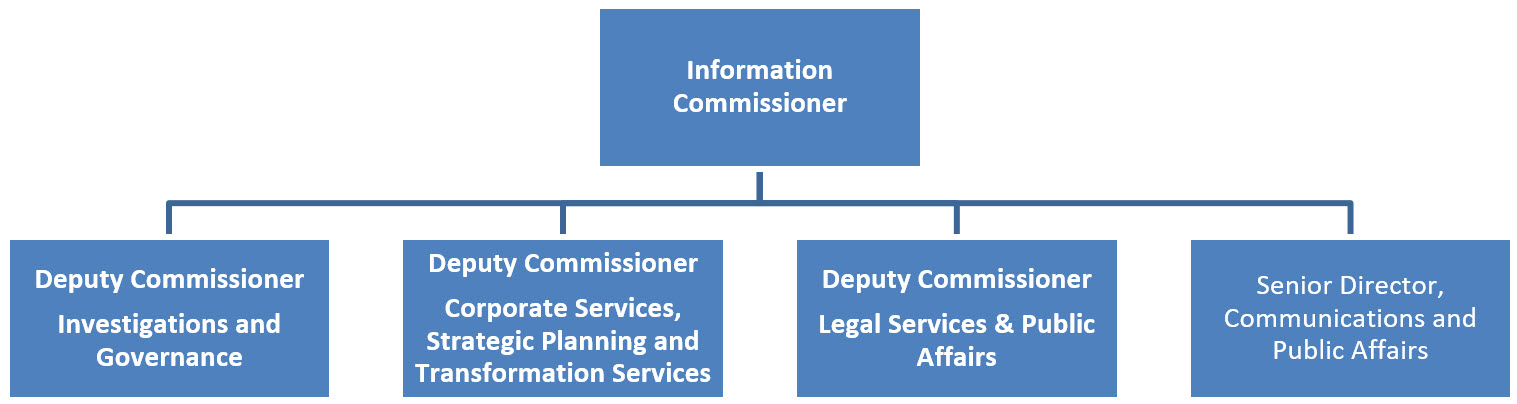
The senior management organizational structure is shown in the diagram above.
Text version
This hierarchal chart shows the organizational chart at the Office of the Information Commissioner. The Information Commissioner is at the top of the hierarchy as the head of the organization. On the second level, there are the Deputy Commissioner of Investigations and Governance, the Deputy Commissioner of Legal Services, the Deputy Commissioner of Corporate Services, Strategic Planning and Transformation Services and the Senior Director, Communications and Public Affairs.
Progress on Implementation of the 2021/22-2024/25 OIC Audit and Evaluation Plan
The progress made on the engagements identified in the previous RBAEP is stated in the table below.
| Planned Year | Audit Project Name | Primary OIC Entity | Status |
|---|---|---|---|
2021-22 and 2022-23 | Program Evaluation of Investigations | Senior Management and Complaints Resolution | Completed Phase I – Evaluation of Registry 2021-22 Phase II – Evaluation of the Investigation and Governance (rest of the program) 2022-23 |
2021-22 | Performance and Talent Management Review | Human Resources (HR) | Completed Replaced by Public Service Commission Staffing Evaluation which was done by External Quality Assurance Provider in 2021-22 |
2022-23 | Audit of Information Management and Physical Security | Corporate Services | Removed. Activity was Replaced by Development of Departmental Security Plan (DSP) and Business Continuity Plan (BCP). |
2023-24 | Cyber Security Maturity Assessment | IT/IM & Security Management | Recommendations of the Management Action Plan are in progress |
2023-24 | Complainant Consultation regarding the Office of the Information Commissioner’s Investigations Program | Investigations | Completed – will reassess certain findings once OIC transfers to a cloud environment |
2024-25 | Real-Time Internal Audit of the Cyber Security Event Management Action Plan (CSEMP) | IT/IM & Security Management | Recommendations of the Management Action Plan in progress |
OIC Key Organizational Risks (2026-27)
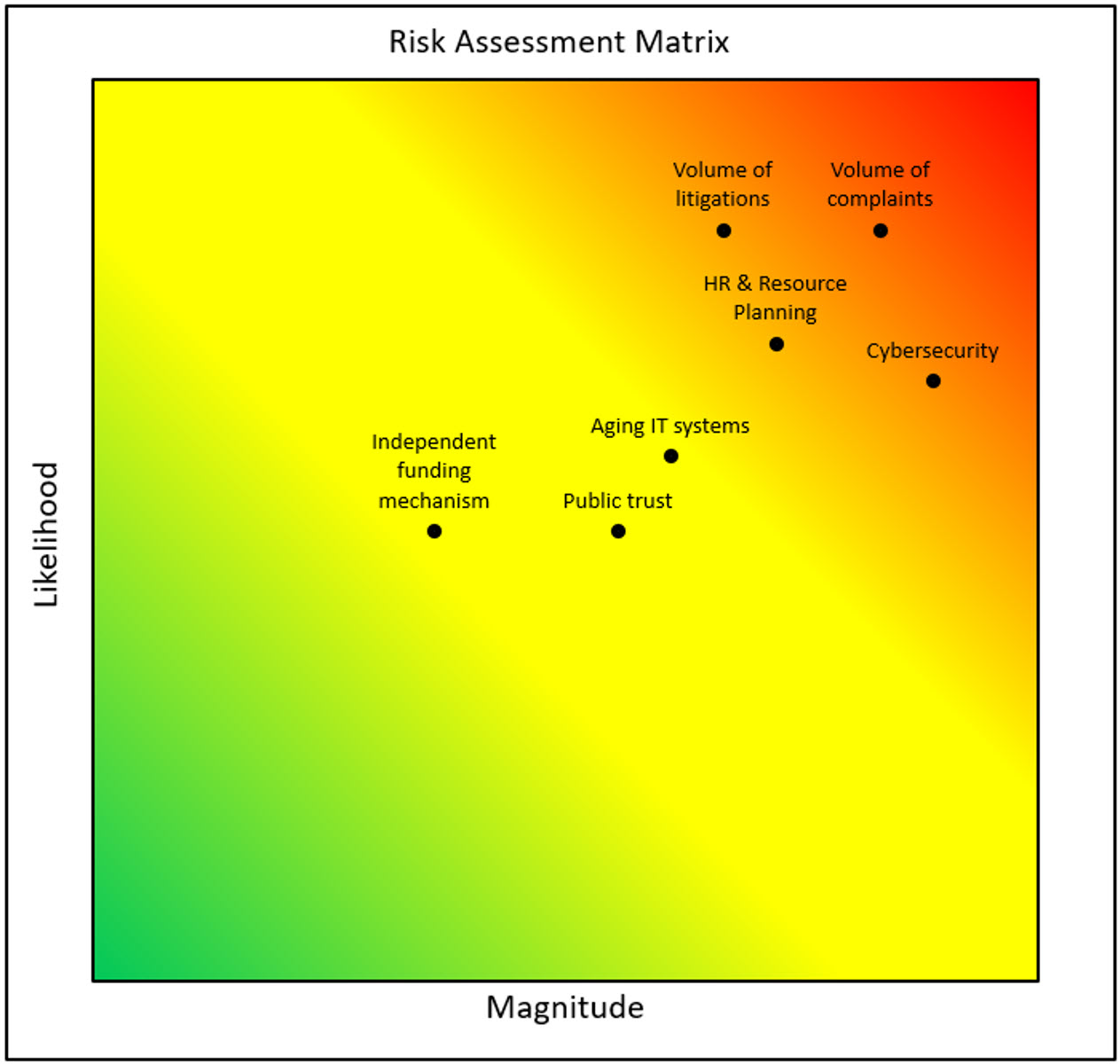
The OIC’s key risks are documented in the Corporate Risk Register included in the OIC Corporate Risk Profile which was developed with the input from Senior Management and the Audit & Evaluation Committee. The OIC’s key risks are summarized in the following Risk Assessment Matrix:
Text version
This Risk Assessment Matrix ranks key organization risks based on their likelihood and magnitude. The risks were ranked on a scale of 1 (low) to 10 (high) for their potential likelihood and magnitude. The risks were scored as follow:
For volume of complaints, the score was magnitude 7.5 and likelihood 5.
For volume of litigations, the score was magnitude 6 and likelihood 6.
For cybersecurity, the score was magnitude 8 and likelihood 4.
For human resources and resource planning, the score was magnitude 5 and likelihood 4.
For aging information technology systems, the score was magnitude 5.5 and likelihood 3.5.
For public trust, the score was magnitude 5 and likelihood 3.
For independent funding mechanism, the score was magnitude 3.25 and likelihood 3.
OCG Audit Areas for Small Department Risks
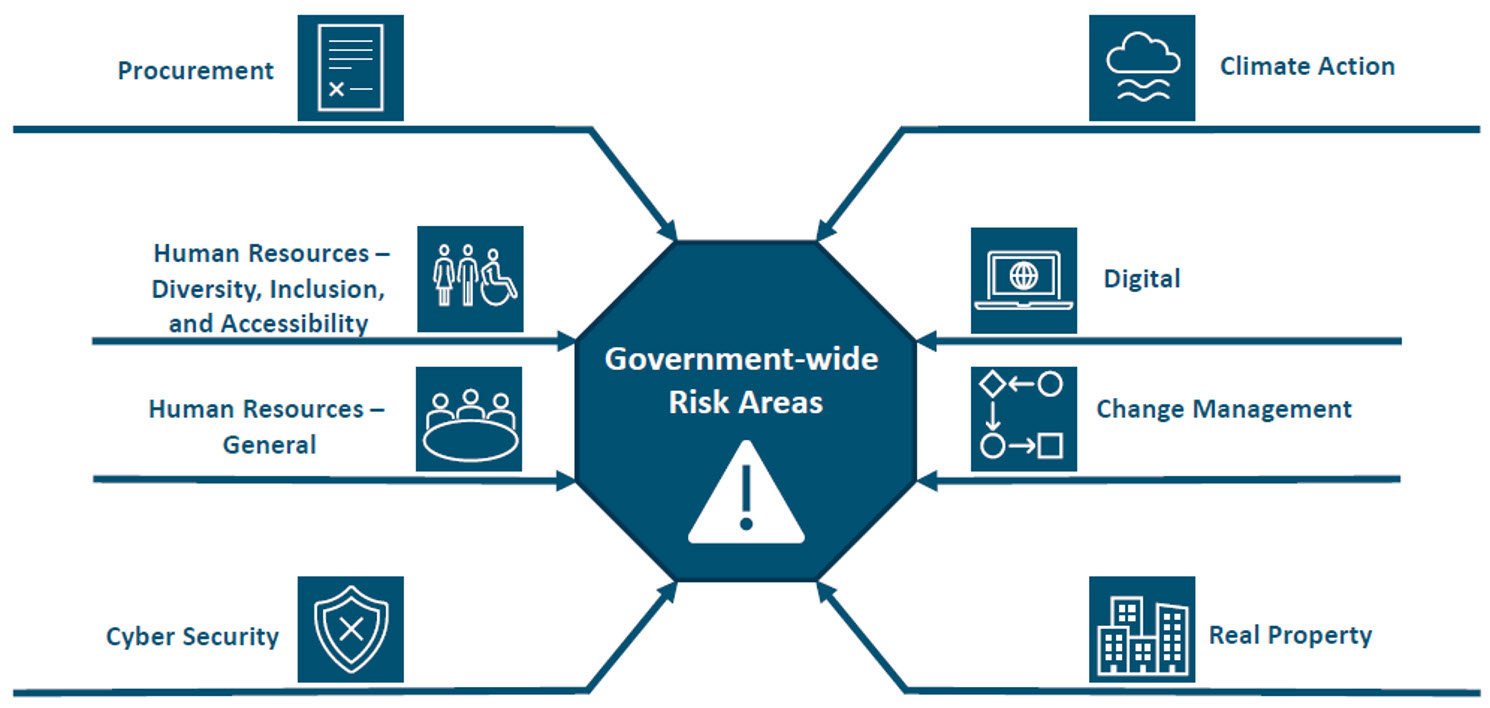
The OCG is responsible for providing central audit and oversight to a group of small government departments and regional development agencies. These departments and agencies, which have fewer than 500 employees and a maximum of an annual approved expenditure of $300 million, are overseen by a Small Departments and Agencies (SDA) audit committee consisting of externally appointed members. While the OIC, as an independent Agent of Parliament, is not subject to this oversight, it does, nonetheless, choose to consider the SDA high-risk categories that the OCG has established in its audit plan priorities. The OCG has identified eight key risk areas:
Version textuelle
This graphic shows the eight government-aide risk areas identified by the Office of the Comptroller General. The eight areas are procurement, human resources (diversity, inclusion, accessibility), human resources (general), cyber security, climate action, digital, change management, and real property.
For the period 2025-26 to 2026-27, the OCG is conducting the following horizontal audit engagements:
| Planned Year | Audit Project Name | Preliminary Objective |
|---|---|---|
2025-26 | Going Digital | To determine whether TBS has developed and shared standards and guidance on going digital that are aligned with best practices, and that departments have taken action to adopt and implement the applicable standards and requirements. |
2025-26 | Core Control Self-Assessment Tools Consolidated Results Report | To help raise awareness of key financial management core controls in SDAs; empower departments to assess, maintain and improve core controls, as needed, in between audit cycles; and help individual SDAs (covered under the OCG mandate) gain further perspective on how their results stand relative to the SDA community. |
2025-26 | Horizontal Information Management (IM) Engagement | A horizontal assurance or advisory engagement focused on IM will be undertaken in a selection of SDAs only |
2026-27 | Risk Compliance Process (RCP) | TBS launched the new RCP in June 2025 and many SDAs will be adapting to this new reporting requirement. Results are expected in December 2025 and could inform where internal audit services can add value. |
To avoid duplication of effort and burden on the organization, the OIC considers the work of the OCG in the planning of its own assurance activities. In addition, observations and recommendations from OCG engagements – even if the OIC is not in scope – will be assessed for applicability and incorporated into the operations of the organization.
Planning Approach
Internal Audit Plan
Internal audits provide independentNote de bas de page 1, objective and substantiated conclusions on the effectiveness of risk management, control and governance processes. The focus is on all management systems, processes and practices, including the integrity of financial and non-financial information. Internal audit assurance services provide evidence-based opinions on the extent to which the system of internal controls is adequate and effective to support the following imperatives:
- achievement of operational objectives
- safeguarding of assets
- economy and efficiency of operations
- reliability and integrity of financial and operational information
- compliance with legislation, policies and procedures
In accordance with TBS policy, internal audit plans must ensure coverage of areas of higher risk and significance. The internal audit plan should also have the following characteristics:
- be risk-based
- be reviewed by the audit committee
- be focused predominantly on the provision of assurance services
- have a multi-year horizon
- address risks and internal audits identified by the Comptroller General as part of government-wide coverage
- support annual assurance reporting on the overall state of organizational risk management, control and governance processes
Planning Approach
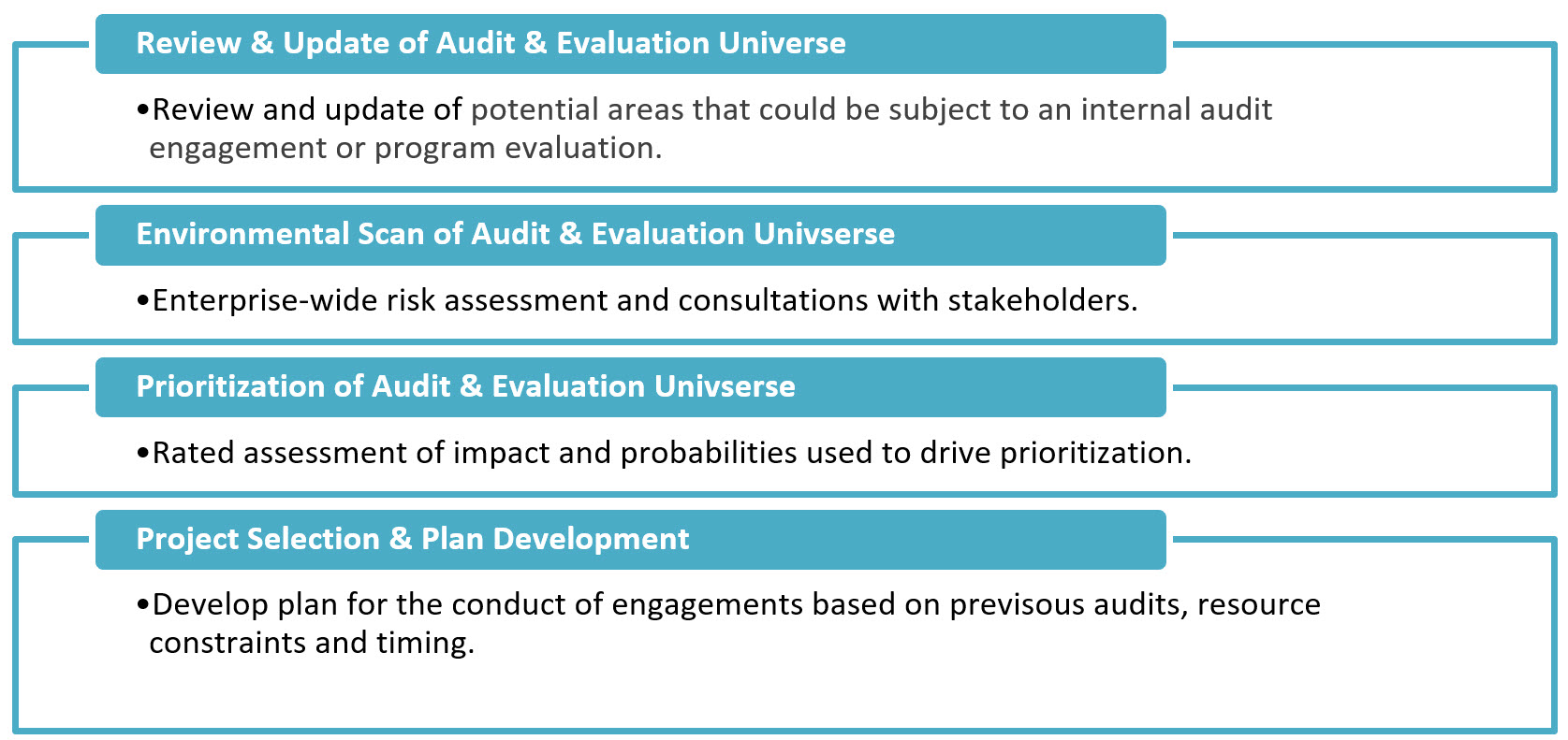
The approach taken to develop the plan complies with the recommended methodology of the Institute of Internal Auditors’ International Professional Practices Framework. The diagram below shows the main elements of the approach.
Text version
Review & Update of Audit & Evaluation Universe
|
Environmental Scan of Audit & Evaluation Universe
|
Prioritization of Audit & Evaluation Universe
|
Project Selection & Plan Development
|
Prioritization of Audit and Evaluation Projects
When determining the areas to be covered by internal audits or evaluations, the OIC looked at:
- Key risks identified in OIC’s Corporate Risk Profile
- Key risks identified by the OCG in their Risk Based Audit Plan
- OIC’s strategic priorities, resources, and structure
- Input from Senior Management and the Audit and Evaluation Committee
The OCG’s key risk areas and OIC’s key risks from the Corporate Risk Profile are shown above.
Project Selection and Plan Development
Audit and evaluation projects were selected to be included in the OIC RBAEP with the highest audit priorities identified serving as the starting point and providing the main but not only consideration for project selection. The top priority risks topics were examined against a variety of constraints and opportunities, including the following:
- recently completed audits (for example cybersecurity is a key risk for both OIC and OCG, but significant work was carried out in this area under the last RBAEP)
- feasibility of conducting an audit or evaluation (for example the volume of complaints and funding mechanism are key risks for the OIC but difficult to audit)
- availability of audit and evaluation resources over the three-year period
- other reviews providing oversight (i.e. OCG evaluations, Office of the Auditor General (OAG) audits)
- areas already covered by internal control testing
- mandated audit projects (i.e. follow-ups, OAG, OCG and Public Service Commission obligations for horizontal audits)
- risk tolerance
- management requests
- Audit & Evaluation Committee and senior management direction
In finalizing the RBAEP, care was taken to ensure the audit and evaluation universe was appropriately covered. The RBAEP reinforces the integration of audit and evaluation projects, when feasible, while ensuring evaluation coverage of all direct program spending.
Audit and Evaluation Plan and Summary
Given the relatively small size of the OIC and the associated resource constraints, it is realistic to target the undertaking of one assurance-type engagement per year. This approach considers the available financial and human resources within the OIC. It also ensures that the necessary time and effort can be dedicated to conducting a thorough and comprehensive audit or evaluation.
The limited size of the organization necessitates a focused and prioritized approach to the allocation of resources for assurance engagements. By conducting one engagement per year, the OIC can concentrate its efforts on addressing key risks and priorities, while still maintaining its day-to-day operational demands. This approach allows for the necessary planning, execution, and reporting phases of the engagements to be carried out effectively, ensuring quality and comprehensive results.
By setting this realistic target, the OIC can optimize the use of its limited resources and achieve meaningful outcomes from each assurance engagement. It allows for a thorough examination of the identified risks and priorities within the organization, while still considering the constraints and capacity of the OIC as a small-sized entity.
The OIC also performs annual testing of internal controls which supplements the internal audit and evaluations.
Detailed Audit and Evaluation Plan (2026/27-2029/30)
The table below provides the objective, scope and rationale for each of the planned projects proposed for 2025-26 to 2028-29. It should be noted that these may be modified depending on the results of the planning phases of each of the respective projects. In addition to the audit projects below, internal auditors will continue to attend key management and Audit and Evaluation Committee meetings, and conduct follow-ups on previous audits (as appropriate).
| Year | Audit Project Name | Primary Entity | Audit Scope, Objective and Rationale |
|---|---|---|---|
2026-27 (audit planning) 2027-28 (audit execution and reporting) | Internal Audit of Procurement | Finance & Procurement at CHRC | Note: This audit was originally planned for 2028-29. Given government wide risks related to procurement and additional procurement independence granted to Agents of Parliament, this audit has been advanced. Objective The objective is to assess OIC’s procurement policies & procedures and ensure compliance with government-wide procurement policies & best practices. The internal audit aims to identify strengths, weaknesses, and any issues that impact procurement at the OIC. Recommendations will be provided on improving procurement practices at the OIC. Scope The scope of the engagement will include all factors impacting procurement and will likely take the form of:
Rationale This is a high-risk area across government as identified by the OCG. Issues with procurement have been highlighted in recent OAG audit reports and in media coverage which cause reputational problems for organizations impacted. In addition, as an Agent of Parliament the OIC is granted additional procurement independence from Public Services & Procurement Canada and it is important that the OIC exercise these additional procurement powers responsibly. |
2028-29 | There is a one year planned hiatus for formal internal audit and evaluations in 2028-29. The justification for this decision is:
| ||
2029-30 (originally planned in 2026-27) | Internal Audit of Human Resources practices (Employee Retention) | Human Resources Management | Note: This audit was originally planned for 2026-27. Given changes in Government-wide operations, employee turnover is expected to be lower over the next several years and as a result this audit has been moved to a later year. Furthermore, the Public Service Commission (PSC) just completed OIC’s Staffing Cyclical Evaluation which demonstrated significant improvements and compliance compared to the last exercise conducted in 2021. Some recommendations will be integrated in our HR business processes. Objective The objective is to assess OIC’s employee retention practices and factors. The internal audit aims to identify strengths, weaknesses, and underlying causes of turnover and factors influencing employee engagement. Recommendations will be provided on improving employee retention rates and enhance overall workforce satisfaction and commitment. Scope
Rationale Like most Government of Canada organizations, the OIC’s workforce is its most important asset in delivering on its mandate. An engagement of this nature will provide senior management with valuable observations and recommendations to help identify opportunities for improvement and strengthen employee retention and engagement. An internal audit with a related objective and scope was previously planned for the 2021-22 fiscal year. However, it was replaced by an external assurance review that was conducted by the Public Service Commission of Canada and external expert advisor. |